Wednesday, 2 May 2012

Salted Fish Trotter Stew


When I was young, we always had a whole salted fish hanging in the kitchen like some dried up artifact from the museum. In fact, the smell of the salted fish and the well-used kitchen always gave me a comfortable feeling of home.
Salted fish was cheap, and it could keep, and was versatile. Needless to say it was a regular fixture on the dining table: steamed by itself or cooked in what seemed like 101 ways with meat and vegetables, or even in soups.

There are many kinds of salted fish in the market. The soft types have more pungent smells and intense flavors; they are great for steaming just on their own or cooked in combination with other meats, vegetables or fish. The hard types of salted fish usually need to be deep-fried before being consumed; they are great with fried bean sprouts or kailan.

Salted fish is no longer cheap; in Singapore and Malaysia, salted mackerel in the soft form are most prized. These particular variant comes from Malaysia and they are expensive.

My family firmly believed in not wasting any food; every part of the salted fish was put to good use, even the head. We’d cook the fish head in sauce or as a stew or soup. Here are two recipes that we usually prepared at home.


Salted Fish Pork Trotter Stew

Pork trotter (fore leg)            800 g, chopped
Garlic                                       ½ kg, whole
Fried salted fish                       3 tbsp.
Stock                                       3 cups

Salted Fish Sauce

Oil                                           6 tbsp.
Shallots                                   10, minced
Sugar                                       2 tbsp.
Garlic                                       5 minced
Salted fish/head                      200 g, bone removed
Water                                      ¼ cup

Method:
1.    Boil pork trotter for ten minutes. Drain and rinse the trotter thoroughly than dry it.
2.    Put trotter, 250 g of garlic, salted fish sauce and stock in a heavy saucepan. Rapid-boil the trotter for 10 minutes and continue to simmer for 1½ hours.
3.     Replace the remaining garlic and continue to simmer for another 30 minutes.
4.     Season it with sugar and salt.
5.     Serve the trotter with the garlic, and sprinkle fried salted fish over it before serving.

Salted Fish Sauce
1.     Sauté shallots and garlic until it turns translucent.
2.     Add sugar and continue to fry until it is caramelized.
3.     Add salted fish and water and simmer until it reduces by 1/3.
4.     Cool and chill for further use.

Tuesday, 24 April 2012

Fried Rabbitfish Porridge – A Simple Treat


I am Cantonese; my great-grandfather left Guangzhou, a city in southern China, to seek a better life. And now here I am fourth generations down the line. My clan and I have assimilated well in language, lifestyle, and outlook on life, wherever we may live these days. But when it comes to taste buds, I still slant towards Chinese…and, in particular, Cantonese food.

Those who know Cantonese food, know that there are a few staples we Cantonese cannot live without. One of them is soup; any kind of soup – boiled, double-boiled, and even quick-boiled – with ingredients picked and selected according to the season.

The other staples that regular appear on the Cantonese dining table are rice and congee. I have loved congee since childhood. In fact, I was told that my first “solid” food after weaning was fish congee. When it comes to congee, my family seems to have 101 recipes; and this is one of my favorites – rabbitfish congee.

Rabbitfish is a common fish in the market and also very affordable; except during Lunar New Year. Because at that time of year, the fish becomes filled with roe and the Teochew (another Chinese dialect group from Guangzhou) prize it above all other fish, and would willingly pay obscene amounts for it.

The rabbitfish I have encountered in Hong King are about 10cm in length and may be easily caught by weekend anglers from the shore; their counterparts in Singapore tend to be bigger at around 25cm. Rabbitfish could become bitter if the gall is accidentally ruptured during cleaning. Other than that, the meat of this fish is tasty whether steamed or fried.

I have introduced a method of preparing congee in an earlier post (http://gastronautdiary. blogspot.com/2011_12_10_archive.html). However, the method that I’m posting now is more traditional and seldom practiced, even in restaurants; and it produces congee with a texture and taste that is so much better, even when eaten plain.

So what do we look for in a plain bowl of congee? First, it should smell of rice. The Chinese call it ““ or literally “breath of rice”. This smell should be full bodied yet fresh. Next, the congee texture should be gluey without any lumpy grains. The rice and oil should be well emulsified, leaving no trace of oil visible in the congee. Finally, the color of the congee should be pale white and not cream.

 Fried Rabbitfish Congee

Rabbitfish                    1 kg or more
Rice                             100 g
Glutinous rice             12 g
Thai jasmine rice         12 g

Lard                             25 g

Salt                              2 tsp
Water                          2.75 litres
Ginger                         50 g, julienned
Salt                              1 tbsp
Soy sauce                    1 tbsp
Sesame oil                  ½  tbsp.
White pepper              a dash
Spring onion               garnish
Fried shallots               2 tbsp


Method:
  1. Mix all rice with lard, salt and water, and let it rest for 30 minutes.
  2. Add rice to boiling water, and let it boil vigorously for 1½ hours.
  3. Add fish and ginger, continue to boil over medium flame for another 30 minutes.
  4. Season it with salt.
  5. Add a dash of soy sauce, sesame oil, pepper, spring onion and fried shallots.

Fried RabbitFish
1.   Get the fishmonger to remove the guts, but if you have to do it yourself, try not to tear the gall or the belly meat will turn bitter.
2.   Apply salt to the fish and let it marinate for 15 minutes.
3.   Rinse the fish well and drain.
4.   Fry fish until both sides turn slightly brown.
5.   Remove bones and set the meat aside.

Note:
It is necessary to boil the congee under both high and medium flame as this will ensure that the rice and water emulsify well. Never simmer the congee; and do not add any water to it while it is cooking. However, if there is a need to add water, make sure it is boiling water.

Monday, 23 April 2012

St Pierre Springs into the Limelight


Chef Leandros Stagogiannis may be a bear of a man with a balloon of frizzy hair to match (think Hagrid from Harry Potter!), but he has nimble fingers when it comes to food plating, and the sharpest of taste buds to match.

The Chef is not a newcomer to our shores, but he’s kept a pretty low profile during his three years at Restaurant 53. Now, with his debut as the new Chef de Cuisine at Saint Pierre, he seems ready for the spotlight.

I had the opportunity recently to sample the Spring Menu he developed. Its first entrée, Salmon Roll with Scallop Mousse, was a tad predictable but nevertheless a refreshing teaser for the taste buds. Happily, there was a lot more to come.

Foie gras had always been Saint Pierre’s calling card -- the must-try ingredient that showcases the restaurant’s technique and creativity. In the foie gras dish of the Spring Menu, Chef Stagogiannis used caramelized green apples and old port sauce to develop a tri-layered note for the nose as well as the tongue. The first bite delivered two sensations at once: the sweetness, mellowness, and richness of the old port sauce, and the tartness of the green apple. The rich and creamy taste of foie gras rounded off the symphony; three layers of flavor melding into a titillating orgy on the tongue. Sexy, mature, and exciting!

Next, the colorful heirloom vegetables of the dish, Heritage, delighted the eye and palate as each vegetable entered the mouth. The red and ‘limp’ watermelon was the biggest surprise: frozen, then pressed steamed, each stage of preparation had changed the taste and texture of the watermelon; the end result was a fruit with the texture of liver, yet with intense sweetness. While I reckon you can call it a dessert, to me the watermelon better served as complement to the rest of the vegetables, such as the yam and parsnip fries in hazelnut butter.

I ordered the dish, Le Jardin, on a whim. It was an interesting play of bamboo shoot, lotus root, sweet potato, burdock root, shishito, kabocha, momotaro tomato and banana flower, arranged with an ikebana Zen-ness that reflected its Japanese ingredients. I was surprised to learn that this dish was on the menu since way before Chef Stagogiannis came onboard-- maybe I was too busy looking at other dishes to notice!

I have never liked my salmon cooked, but when Chef added wakame as the “fifth taste” to the vanilla oil-poached meat of the fish, it worked for me. Eating the smooth-textured salmon felt almost like eating sashimi, and the chanteclaire apple reminded me of early spring in Tokyo.

It is really hard to find well-cooked sweet bread in Singapore, but Chef did justice to the dish. Resembling pig brain in texture, the sweet bread was delicious with the garlic dressing and white asparagus. The plating brought me back to Restaurant 53 with its signature hay nest.

The last time I remembered having vegetable as part of a dessert was at Pierre in Hong Kong. Chef Pierre Gagnaire had engineered the lettuce brilliantly and made it the main ingredient of the dessert. It was unforgettable. Here, Chef Stagogiannis used celery as the surprise choice. The tanginess of celery worked surprising well with the strawberries with chocolate crumble and sorbet. It took confidence to pull this one off, and Chef Stagogiannis, who was once the pastry chef at The Fat Duck, as well as pastry consultant with Gordon Ramsay’s Maze and Maze Grill, did it with aplomb.

We rounded up the night with chocolate ganache with a hint of soy sauce and parsnip -- a fitting finale I thought. Although my dinner companion wasn’t bowled over, I thought this dessert represented the Chef’s artistic approach nicely. To me, it seems that Chef Stagogiannis -- as a chef as well as a trendy artisan -- captures the “in” style of cooking as well as food presentation unfailingly, every time. Now, perhaps, the interior of the restaurant has some catching up to do, in order to live up to this revitalized menu.

Saint Pierre
#01-01 Central Mall
3 Magazine Road
Singapore

Monday, 9 April 2012

Steamed Crab Glutinous Rice---A Dish for all Seasons


In Singapore, we eat glutinous rice all year round regardless of season or weather. So when I moved to Hong Kong a couple of years back, and was told that glutinous rice was eaten mostly during the cool season, I was quite surprised. And, if the warming global climate is anything to go by, and the past two winters in HK any indication of things to come, glutinous rice might soon be an extinct dish!

Anyway, I love glutinous rice whichever way it is cooked---dumpling, fried, steamed, and especially in this featured recipe. I ate this version long ago when I was young, and had all but forgotten it, until I encountered it again at Chef Ang Sang Kang (better known as Chef Kang)’s tiny and rather stifling shop located in an HDB block in Serangoon. Later, in a seemingly roller-coaster career that saw a few ups and downs, Chef Kang moved to bigger premises in Joo Chiat, and finally to his present restaurant, Canton Recipes House, at a hotel in Albert Street. Having said that, a meal at Chef Kang’s, wherever he’s located, has always proven a treat.

This is a simple recipe that I learned from some chefs in Hong Kong, and which I’ve tweaked a little. In this recipe, it is important to use garlic in the form of a paste prepared beforehand, instead of as raw chopped garlic added just before steaming. The reason being that cooked garlic paste would be more robust and mellow in taste, and would come in handy for other recipes too!

Steamed Glutinous Rice with Crab

Glutinous rice             300 g
Water                            5 cups
Salt                                 1½ tsp
Chicken broth             3 tbsp
Light soy sauce           1 tbsp
Crab                               1 or 2, depending on size
Garlic paste                 2 tbsp
Spring onion
White pepper


Method:
  1. Soak glutinous rice with 5 cups of water. Drain the rice thoroughly after 3 hours. Add salt in the rice and mix well.
  2. Steam rice for 30 minutes. Sprinkle 2 tbsp of chicken broth and continue to steam for another 10 minutes.
  3. In between, sprinkle light soy sauce onto the rice.
  4. Add crab and garlic paste and steam for another 9 minutes.
  5. Sprinkle spring onions and pepper before serving.

Garlic paste:
Garlic                         8, finely chopped
Oil                              8 tbsp
Salt                            ¼ tsp

Method:
1.              Fry garlic and salt under low heat.
2.              Keep stirring until the garlic is cooked and could be mashed easier.
3.              Remove and keep in a cool corner.

Tuesday, 27 March 2012

Killer Dim Sum!


I first heard about it in November of 2011 -- how famed masterchef Chen Xun had been coaxed out of retirement for a month-long dim sum promotion in Guangzhou. I was not able to make that trip, and have regretted it since. It was a meal I would have gladly killed for.

The Guangzhou-based 87-year-old Chen is regarded as one of the greatest dim sum masters of his generation. He is advisor to the Guangzhou Culinary Association and author of many cookbooks.

赤绳欣系足
So imagine my surprise and glee when I learned that the masterchef had been invited to repeat his feat, this time in Hong Kong for two weeks. A few days back I finally found myself seated at Nanhai No.1 restaurant in Tsimshatsui, looking at dim sum that had been served by Chen since the 1940s.

We opened with Steamed Mountain Yam and Duck Web with Bean Curd Skin (right). The duck web had been braised and steamed along with the yam, allowing the yam, which was tied together with string made from an omelette, to thoroughly imbibe the flavour of the duck web. The taste was subtle with a light hint of superior soy sauce.
彩风隐龙怀
Next came Steamed Prawn stuffed with Quail Egg (left).  The prawn was minced and beaten into a paste that was smooth and slightly crunchy. The acid test for me was the taste of prawn, which came through with light seasoning. The quail egg also gave a heavier body to the bite.

This was followed by morsel-sized pastry birds, actually Baked Chicken Liver Pastry seasoned with Spring Onion Oil (below, left). The liver was light in taste, unlike the heftier flavour of most chicken liver. The pastry was typically Chinese in style, and a little on the heavy side with a hint of spring onion oil.
葱油凤肝酥 (left), 窝烧鸭脑饼 (right)

The fourth item was unusual---Baked Duck’s Brain Pancake with Cinnamon Flavour (above, right).  Each pancake used two duck brains blended with minced meat. The taste of duck brain was subtle but the texture was unforgettable. It reminded me of tofu but with a meatier smoked taste. My favorite!
茄汁鲜虾饺

When the ha kou was presented, it looked like any other ha kou except for a pronounced red blush shining through the skin. The first bite of the Steamed Shrimp Dumpling with Fresh Tomato (right) produced a light hint of tomato sourness accompanied by the crunch of prawn paste.  But the second bite clearly justified the presence of the tomato paste; the flavor of tomato and prawns is a marriage made in heaven. Yum!

I’ve never been fond of chicken siu mai (below, right), and the only occasion I would eat chicken siu mai would be in Muslim Malaysia, where the use of pork in hotel restaurants is forbidden. But Masterchef Chen Xun’s version was exquisite, the meat finely chopped and marinated with superior oyster and soy sauces. The meat on its own was already flavoursome but the marinate enhanced it even further.
网油牛肉卷 (left),  鸡茸干蒸卖 (right)

The Steamed Beef Ball (above, left) was lean beef hand-chopped, and wrapped in caul-oil which serves to moisten the meatball during steaming. The beef was further enhanced with dried mandarin peel, water chestnut, lemon leaves and coriander. From the first bite the parade of flavours from the ingredients came through, one after another!

柚皮火腩夹
The preparation of pomelo skin is always tedious and time-consuming, making pomelo skin as an ingredient a rare treat in restaurants. Masterchef Chen Xun mixed Pomelo Skin with Pork Belly (left) and cooked it until soft. The final mixture was then stuffed into a bun and steamed for about 20 minutes, giving it a refreshing taste quite unlike the usual char siu or chicken bun. Furthermore, the pomelo skin soaked in the oil from the pork belly, while sending hints of fruitiness seeping through the meat.

Two desserts were prepared and served for this promotion. The first was lotus paste coated with flour mixture and sesame seeds (below, right), and deep-fried until golden brown. The lotus paste was light and not too sweet like most Chinese desserts. And the sesame seeds gave a nice bite with a pungent seedy flavor.
波渣香麻条

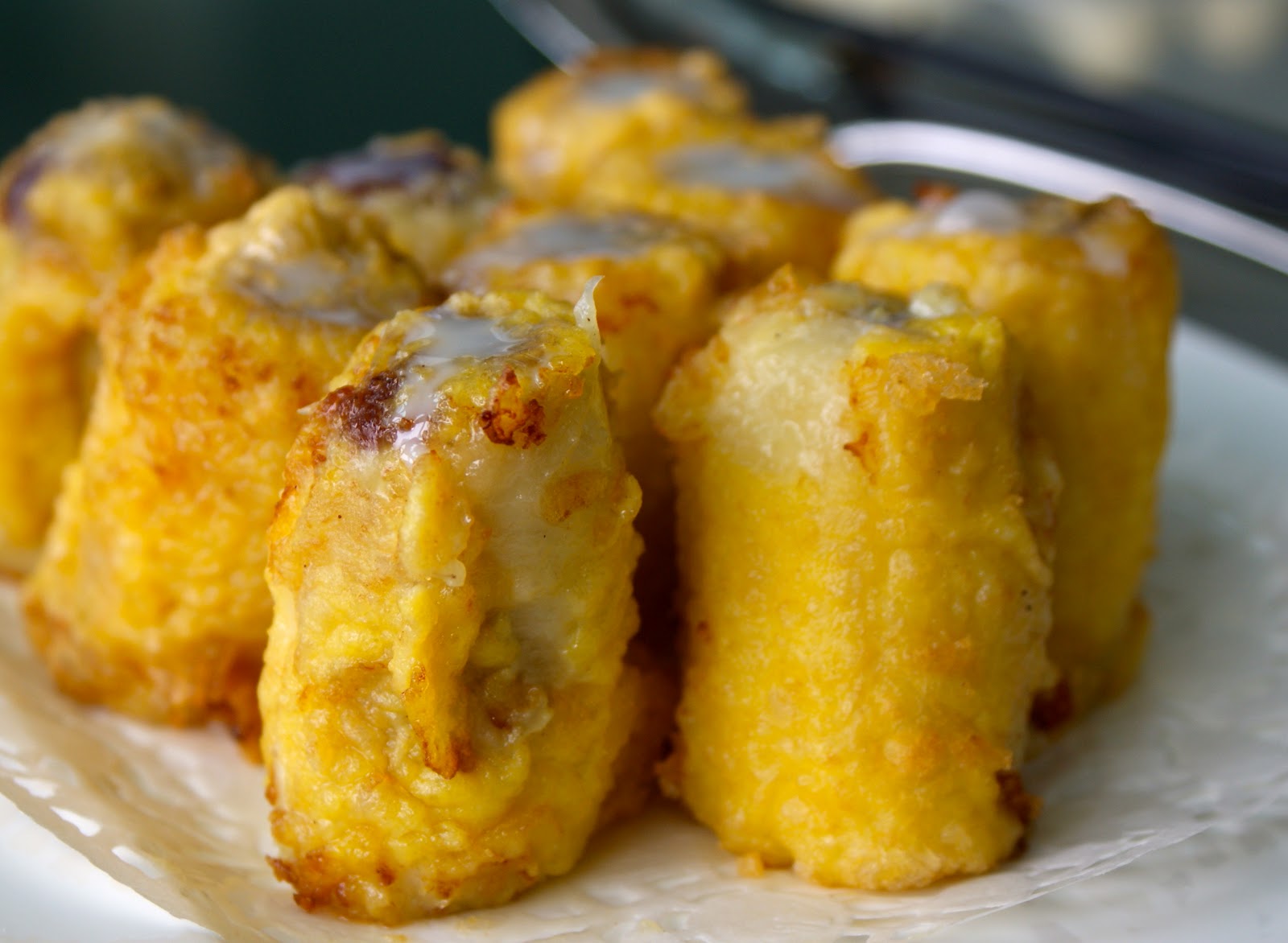
The last dessert was my favourite -- deep-fried Banana stuffed with Red Bean Paste (below, left). The combination was refreshing and somehow tasted modern. But the restaurant staff assured me that such a combination had already existed more than 50 years ago.

NANHAI NO. 1
Level 30, iSquare
63 Nathan Road
Tsimshatsui, Kowloon
HONG KONG
Tel:   852 2487 3688

脱衣换锦袍