In my
wildest dreams, I couldn’t have imagined this.
Two living
legends of early Singapore cuisine – Masterchefs Sin Leong and Hooi Kok Wai –
graciously took the time to make my dream come true four nights ago. By recreating
long-forgotten dishes of the 1950s and 60s, they brought back some of the most
cherished childhood memories of mine and of the 30 friends who shared the dinner
table with me.
Like all “golden
eras” it’s hard to pin it down to precise dates, but the flowering of Cantonese cuisine, as we know it, probably
began in the 1920s. It was a time of economic and political turmoil -- and
extremes. The rich wallowed in luxury and excess, while the poor starved and
left China in the millions to seek better lives elsewhere.
In
southern China, Guangzhou became the epicenter of life: the place to wine and dine and live it up. Four great restaurants
dominated the city -- Da San Yuan (大三元), Wen Yuan (文园), Nan
Yuan (南园), and Xi
Yuan (西园). They
created dishes that lived on in Cantonese restaurant menus all over the world.
The cooking styles and techniques they pioneered are the principal
stock-in-trades of any respectable Cantonese chef today. And while catering to
the lavish tastes of the era, they established the cult of the so-called “Four
Treasures of Cantonese Cuisine” -- dried abalone, sea cucumber, shark’s fin and
fish maw – and raised it to mythic status within Cantonese fine cooking.
Braised
superior shark’s fin (六十元大裙翅) was the calling card of Da San Yuan. In the 1930s, to eat a bowl of
this dish would cost the diner the equivalent of 14 baskets of rice padi. To produce 2 liters of its stock required 15
kg of meat and Chinese ham, and four hours of brewing. Only the elite could
afford it, and the dish remained but a dream to the masses.
Stuffed Chicken (江南百花鸡), the signature dish of Wen Yuan, was a display of virtuosic skill. The
chicken was gutted leaving just the skin intact. A mixture of prawn and lard
paste, about 2.5-cm thick, was pressed onto the skin, then steamed, cut and
rearranged on a plate. Thick gravy made of superior broth was poured over the
“chicken” just before serving. How expertly the cleaver was handled, and the preparation
of the prawn paste, became the measures of the dish’s success.
Nan
Yuan’s gift to posterity was its braised sliced abalone (红烧大纲鲍片). Each abalone was still alive when
dried, a process that created a “soft” center that was unique for its time. The
braised abalone, weighing some 200 grams apiece, would be sliced thinly before
serving. The thick gravy that coated each abalone slice would, if perfectly
made, leave the plate dry after the whole abalone had been consumed.
Xi Yuan
was the only vegetarian restaurant in the prestigious list of four. Most
matriarchs and wives among the rich in those days were devoted Buddhists, hence
vegetarian cuisine was popular. The ingredients used in the vegetarian dishes
of Xi Yuan were painstakingly sourced from all over China, especially the
amazing arrays of mushroom, fungi and vegetable. One such famous dish was Ding Wu Vegetable (鼎湖上素), where three of the most expensive
mushrooms and six types of fungi were used in its preparation.
After
WWII, many Cantonese restaurants on the mainland were taken over by the
Communist state. The leading chefs fled, to Hong Kong first and then the rest
of the world. Many arrived in Singapore, and as a result the chefs in the top
Singaporean restaurants of the 40s and 50s were often trained under these newly
arrived Guangzhou immigrants. Skills were taught, absorbed and passed on.
In
Singapore, Cantonese food flourished. Local masters wove local ingredients and
techniques into the culinary melting pot. Alongside old dishes, new homegrown
ones emerged. Game meat was the rage in the 60s and civet cat, anteater and bat
became a common sight in restaurants. At the same time, road-side “cze char”
stalls made sweet sour pork, claypot liver, and black-bean pork ribs with
bitter gourd the popular standards of the working class. And with the arrival
of “nouvelle” style, Cantonese cooking entered a new stage of evolution, which
continues to the present day.
But for
tonight, the gilded age of Cantonese gastronomy lives! We were one lucky group.
Duo jie, maestros!
APPETISERS
DUCK WEB STUFFED WITH
PRAWN PASTE (掌上明珠) was a popular dish in local Chinese fine dining in the 60s. As a kid,
I remember watching a wizened old lady sit in front of Ming Kee, a famous restaurant
in Chinatown. She would use her teeth to “pick” out the bones from the duck web
that would be used in the dish! Prawn paste was then shaped into a ball, placed
on top of the web and steamed. The resulting dish would resemble a human palm
holding a large white pearl, hence the apt Chinese name.
Crystal Pork Trotter
(白雪猪手) requires multiple
repetitions of boiling and soaking in ice water in order to achieve the
jade-like crunchy texture of the meat. The trotter is then soaked in white
vinegar, sugar and wine.
ROAST PORK/LARD COIN
(金钱烤鸡). The fat is pickled
in sugar and Chinese rose wine for at least a few days, turning it translucent
and crunchy. This fat is also used in other Cantonese classics such as Lard
Bun, and Chicken Biscuit. In this dish, pork, crystal lard, and chicken liver
are shaped into round “coins”, skewered and roasted. Tonight, chicken liver had
been omitted.
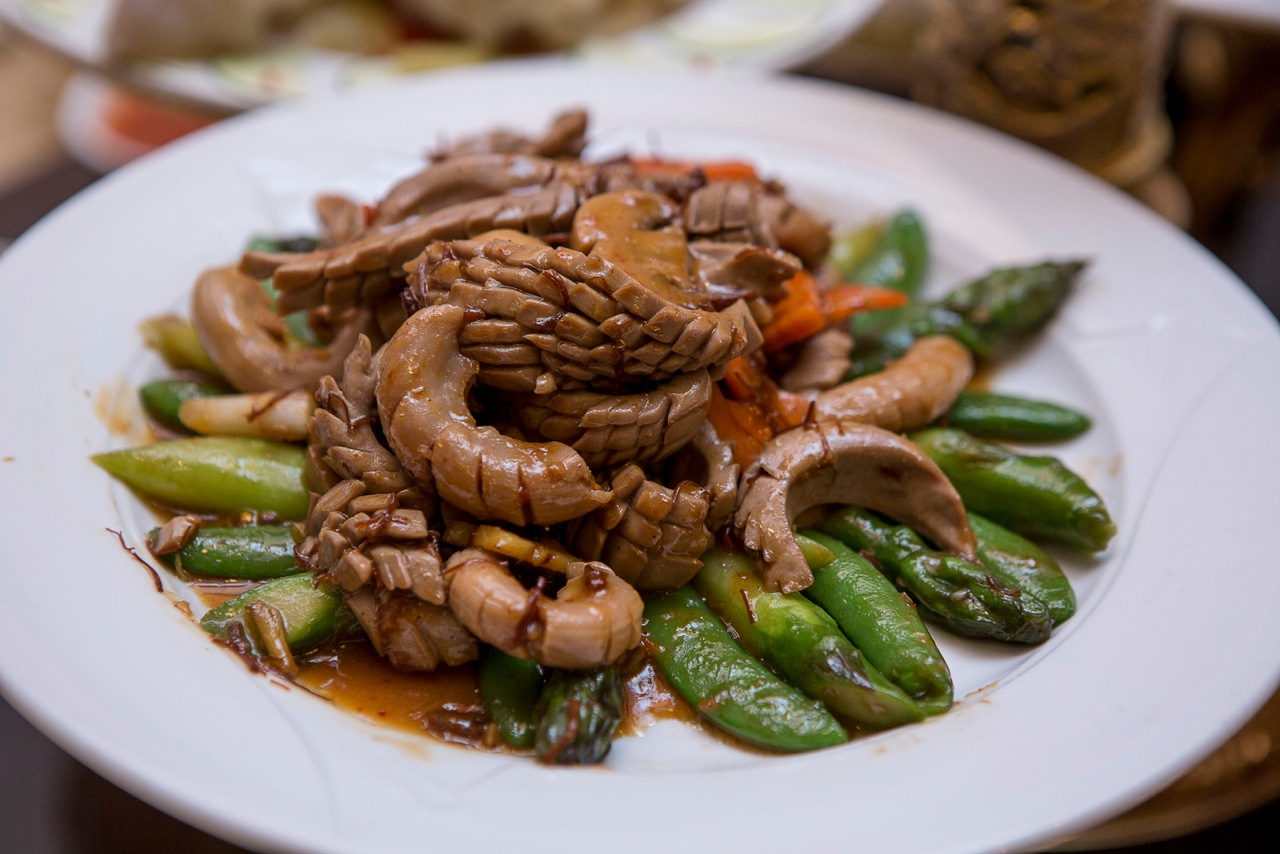
STIR-FRIED PIG’S
INNARDS (同气连枝). Pig’s innards are often used in Cantonese cuisine. Cantonese chefs
are renowned for turning cheap and often discarded meat into exquisite dishes
through the clever use of cooking technique and sauces. Here, pig’s fallopian
tubes and kidneys are prepared and quick-fried. This dish often serves as an accompaniment for
wines.
SOUP
BRAISED SUPERIOR
SHARK’S FIN (凤凰纯大鲍翅) This dish made its appearance in the Ming Dynasty, when the Chinese
empire was “open” and still reaching out to the rest of the world. Guangzhou
and Fuxian were the principal ports-of-call, and both cities enjoyed prosperity
and decadent standards of living brought about by trade. Shark’s fin was the
dish to showcase your skills if you were a top Cantonese chef. It was also a
symbol of luxury. The thick broth was prepared with chicken, pork, and Chinese
ham, and the shark’s fin was then braised for hours in this rich broth.
MAINS
STEAMED GROUPER WITH
PRAWN PASTE (麒麟蒸大石班鱼) is a flamboyant way to display the chef’s cleaver and cooking skills.
The fish is completely deboned, and its flesh scrapped from the skin and made
into paste with prawn, scallop and water chestnut. The paste is then spread on
the fish skin and steamed. This dish was usually served at formal Chinese
dinners.
BRAISED TURTLE WITH
CHESTNUT WRAPPED IN CAUL OIL (粟子纲油红烧山瑞) is a Chinese delicacy served especially at birthday feasts as the
turtle is a Chinese symbol of longevity. Chestnut, dried shitake mushroom, and
roast pork are added to enhance the turtle meat. The mixture is then wrapped in
caul oil to moisten it during braising.
BRAISED PORK BELLY
WITH YAM (三水香竽扣肉配荷叶包) is a versatile Chinese dish served at home as well as at fine dining restaurants.
The key ingredients are simple -- just pork belly and yam -- but it takes
multiple cooking processes to prepare this dish. It was believed that Fujian
produced the best yam in southern China.
 |
| Left - top & bottom: Braised Turtle with Chestnut wrapped in Caul Oil; Right: Brasied Pork Belly with Yam |
DEEP-FRIED NOODLE IN
DUAL SAUCES (鸿图窝面) While yee mee is never served “dry”, neither would it have been deemed
proper to serve it in soup in this instance. So the chef created a light broth
to “soak” the noodle in, and poured a layer of thickened gravy over it to
create a visually appealing dish.
DESSERT
LOHAN PAPAYA SOUP (万寿果甜汤) There was a time that the lohan was
considered an expensive herb used as a soother for throats and a remedy for
coughs. The base of this dessert comes from brewing lohan and papaya with other
ingredients.
RED STAR RESTAURANT
54 Chin Swee Road
#07-23
Singapore 160054
Telephone: 65-6532 5266
Photography by Mark Ong