Showing posts with label Crustaceans. Show all posts

Wednesday, 2 April 2014

Reputation – Bane or Blessing? A Visit to Desmond’s Creation


Chef Desmond Chia needs no introduction. He was one of two sons of the founder of Sik Wai Sin, one of the most reputable zi char restaurants in Singapore, famous for its limited but well-executed Cantonese menu. Diners were known to brave the heat at the non-air-conditioned Sik Wai Sin, waiting hours for a superb “home-cooked” meal. And while his brother presided over the steamed dishes at the restaurant, Desmond was the “man behind the fiery wok”, honing his skills with fried dishes for 13 years.

So when Chef Desmond decided to open his own restaurant, Desmond’s Creation, I had high expectations of it. I arrived at 11.45 am sharp – the opening time shown on their official operating hours; the shutter was down, finally opening at 11.55 am.

It soon became obvious that Desmond ran a tight three-person operation -- two men including himself in the kitchen and a woman manning the dining room. To their credit, and my amazement, things proceeded smoothly throughout the busy lunch hour and food was served without hiccups.

It was also instantly obvious that Desmond was not a risk-taking chef. The menu remained small and 99% of the dishes were “imported” from Sik Wai Sin. My hopes rose even higher upon seeing this, as I reckoned that nothing could possibly go wrong with such a small number of dishes – dishes that the chef had cooked for umpteen years.

The first dish to arrive was Braised Black Bean Pork Rib with Bitter Gourd. Usually, the black bean paste would be well sauted with the meat, and then with the vegetable. Here, I tasted nothing of the “fragrance” of a well-fried dish; it felt like the whole dish had been braised without undergoing fire.


Fried Beef Kailan, which came next, was decent. The vegetable was well fried and perfumed with “wok hei”. The downside was that some beef was cut not across the grain, leaving it a little on the tough side. Also, it would have been perfect had the chef sprinkled on a dash of Chinese wine before serving.

When we were ordering and had asked for tofu, the woman told us bluntly that this dish would come with “big” prawns. I suppose that was how restaurants maneuvered to increase revenue; I also got the impression that those who ate at Desmond’s Creation didn’t mind paying for slightly more “premium” food. Either way, the prawns proved over-cooked and hard. To make the matters worse the tofu was over-fried too. What we ended up with was a plate of hard prawns, dry tofu and diluted gravy.

Steamed Minced Pork with Salted Fish was a personal favourite of mine since I was a kid. In Chef Desmond’s version, he hand-chopped the pork, and this alone earned him loads of brownie points in my book. The glitch in the dish, however, was that he over-mixed the meat, causing the protein to over-bind and making the meat hard rather than crunchy.

But my biggest problem with this dish was the salted fish used. As noted earlier, since the customers were prepared to pay slighter more for their food, Chef Desmond should have opted for better-quality salted fish. The best salted fish (梅香马鲛鱼) for this dish would have been Spanish mackerel aged between 10 months and 3 years. The fish would be prepared by salting and sun-drying it for another 2 years minimum, which would leave the flesh slightly pink near the bones and with a pungent and ‘fleshy’ scent.

Even the portion of the salted fish that Chef Desmond used was too small for the amount of pork in the dish. The salted fish should have been of an amount sufficient to pervade thoroughly the meat and gravy during steaming. In the end, I could only detect a whiff of fish when the plate first landed on the table, and when I actually ate the salted fish itself.

Another downer was the Sweet & Sour Pork. The meat morsels were too small, slightly burnt, and too thickly coated with batter.  The sensation was of eating sweet & sour pork -- in its vegetarian version.

Steamed Fresh Carp with Bean Paste was the best dish of the meal. It was brilliantly executed -- Chef Desmond timed to perfection the cooking of the fish, and the bean paste was well balanced with a cocktail of sourness, sweetness, and savouriness.

These were dishes I had grown up eating from zi char stalls all across Singapore; so, like I said, I had high expectations. Perhaps too high. Perhaps by going it alone when he did, the chef bit off more than he could chew; perhaps his skills and experience fell a little short of his dreams. Perhaps.


Desmond’s Creation or Sik Bao Sin
592 Geylang Road
Singapore
Telephone: 6744 3757

Thursday, 20 February 2014

Sin Huat Eating House - A Meal That Left Me Crabby


Do I trust a foreign food personality to tell me what’s good on our local streets? Apparently not! Sin Huat Eating House won Mr. Anthony Bourdain’s heart and he sang praises (loads of it) on his TV series.


I had heard things about this restaurant. Its owner Chef Danny was known as the Food Nazi of Singapore and diners gladly paid through their noses for his superb, fresh seafood. You didn’t order your meals, so much as have the orders dictated to you by the chef, who would then cook your meal personally. And you wouldn’t know the size of your portion, or its price until the receipt arrived.

Because of this, I took a long time to convince myself -- and save enough money -- to have a first-hand encounter with this much talked about chef.

The restaurant was pretty quiet on the day of my visit, save for two tables of eight and five, and ours. One of my eating companions was a regular and the chef knew him well. Chef Danny offered a rather limited menu, and it seemed 90% of his dishes were de-rigueur with the regulars. We were no different.

Chef Danny delivers his food packed full of very strong flavours, especially garlic. A Singapore celebrity chef once told me, “If I boost my stock and flavours to the maximum, customers would be so overwhelmed that few would be able to tell the difference between good and mediocre cooking”. Chef Danny seems to subscribe to this philosophy.

A case in point was the Steamed Frog’s Legs with Essence of Chicken. Eight bottles of Chicken Essence were poured into a plate of eight perfectly steamed frogs, with garlic. With such an avalanche of robust chicken flavour, little culinary skill was needed for the dish to pack a wallop.

There were other instances. The dish of steamed scallops was overdone but the heavy bath of bean paste sauce was enough to mask its faults, along with much of the intrinsic flavour of the scallop. A similar sauce was used on the fried/braised crayfish. Again, I had to rely largely on my sight to discern what meat I was eating.

A few dishes stood out though. The stir-fried kai lan – usually a simple, supporting dish -- was delicious. It had the right amount of garlic, and the vegetable was crisp and flavoursome. Though it wasn’t cheap, I would gladly pay for it. On the other hand, the MOST cut-throat dish of the evening was the blanched dog conch or simply gong gong to the locals, served with a very tasty dip that was most likely a concoction of oyster sauce, garlic, chilli and buckets of processed flavouring. At $25 per kg, the owner of this restaurant could easily have bought a bungalow in a prime district in no time – if he hasn’t already done so.

The steamed squid was well executed and it was my 2nd favourite dish of the evening. Again the garlic was slightly heavy handed. To his credit, Chef Danny’s handling of the steaming times for the seafood in most of his dishes was near impeccable. However, his main seafood ingredients lacked the flavor of what they were -- they didn't stand out but were buried under his overly strong sauces and dips.  I suspect this is Chef Danny’s trick: to mask and/or distract from his inability to balance his spices and sauces with finesse.

The final dish of braised crab mee hoon was my main purpose for coming to this restaurant; after all this dish made Chef Danny famous in this infamous red-light district. It consisted of two medium crabs and a handful of mee hoon. The mee hoon was very tasty, but lacked the flavour that mattered the most – that of the crab itself. How come? I wondered. Crab imparts a distinctly robust and sweet flavour; and two crabs’ worth of it would certainly have made its presence felt in the dish. Was it buried under heavy MSG or chicken flavouring? I wasn’t sure. But it led to my companions and I consuming ¼ of our national water reserves during the meal and after we got home that night.

Here is my concluding shot: when a foreign food personality or two visits some eatery in Singapore and delivers an encomium, we fall for it hook, line and sinker. Are we so insecure in our own judgments? After all, we, of all people, should know our own food better than anyone. This thought came to me strongly on this occasion. To whip up a tasty dish is not difficult: just load it with MSG and off-the-shelf broths. It's the mastery of precise cooking times that, in my opinion, is Chef Danny's ONLY true achievement. The textures were unfailingly right -- but where were the delicate flavors of seafood? I couldn't detect any of it in all the dishes that I ate. And to me, that's a major letdown.

P.S. I doubted the eight of us could have eaten 3 kg of dog conchs and 3 kg of scallops; but that was what the receipt said.


Sin Huat Seafood Restaurant
659/661 Geylang Road
Singapore
Telephone: 6744 9755

Wednesday, 22 May 2013

The Jumping Table - A Golden Performance By Two Legends


In my wildest dreams, I couldn’t have imagined this.

Two living legends of early Singapore cuisine – Masterchefs Sin Leong and Hooi Kok Wai – graciously took the time to make my dream come true four nights ago. By recreating long-forgotten dishes of the 1950s and 60s, they brought back some of the most cherished childhood memories of mine and of the 30 friends who shared the dinner table with me.

In fact, it was the second time the two maestros had done this. The first was a gorgeous rendition of the classic Cantonese wedding feast on last January. This time around, they had prepared a tribute to the Golden Era of Cantonese cuisine, featuring eight rare dishes.

Like all “golden eras” it’s hard to pin it down to precise dates, but the flowering of Cantonese cuisine, as we know it, probably began in the 1920s. It was a time of economic and political turmoil -- and extremes. The rich wallowed in luxury and excess, while the poor starved and left China in the millions to seek better lives elsewhere.

In southern China, Guangzhou became the epicenter of life: the place to wine and dine and live it up. Four great restaurants dominated the city -- Da San Yuan (大三元), Wen Yuan (文园), Nan Yuan (南园), and Xi Yuan (西园). They created dishes that lived on in Cantonese restaurant menus all over the world. The cooking styles and techniques they pioneered are the principal stock-in-trades of any respectable Cantonese chef today. And while catering to the lavish tastes of the era, they established the cult of the so-called “Four Treasures of Cantonese Cuisine” -- dried abalone, sea cucumber, shark’s fin and fish maw – and raised it to mythic status within Cantonese fine cooking.

Braised superior shark’s fin (六十元大裙翅) was the calling card of Da San Yuan. In the 1930s, to eat a bowl of this dish would cost the diner the equivalent of 14 baskets of rice padi.  To produce 2 liters of its stock required 15 kg of meat and Chinese ham, and four hours of brewing. Only the elite could afford it, and the dish remained but a dream to the masses.

Stuffed Chicken (江南百花鸡), the signature dish of Wen Yuan, was a display of virtuosic skill. The chicken was gutted leaving just the skin intact. A mixture of prawn and lard paste, about 2.5-cm thick, was pressed onto the skin, then steamed, cut and rearranged on a plate. Thick gravy made of superior broth was poured over the “chicken” just before serving. How expertly the cleaver was handled, and the preparation of the prawn paste, became the measures of the dish’s success.

Nan Yuan’s gift to posterity was its braised sliced abalone (红烧大纲鲍片). Each abalone was still alive when dried, a process that created a “soft” center that was unique for its time. The braised abalone, weighing some 200 grams apiece, would be sliced thinly before serving. The thick gravy that coated each abalone slice would, if perfectly made, leave the plate dry after the whole abalone had been consumed.

Xi Yuan was the only vegetarian restaurant in the prestigious list of four. Most matriarchs and wives among the rich in those days were devoted Buddhists, hence vegetarian cuisine was popular. The ingredients used in the vegetarian dishes of Xi Yuan were painstakingly sourced from all over China, especially the amazing arrays of mushroom, fungi and vegetable. One such famous dish was Ding Wu Vegetable (鼎湖上素), where three of the most expensive mushrooms and six types of fungi were used in its preparation.

After WWII, many Cantonese restaurants on the mainland were taken over by the Communist state. The leading chefs fled, to Hong Kong first and then the rest of the world. Many arrived in Singapore, and as a result the chefs in the top Singaporean restaurants of the 40s and 50s were often trained under these newly arrived Guangzhou immigrants. Skills were taught, absorbed and passed on.

In Singapore, Cantonese food flourished. Local masters wove local ingredients and techniques into the culinary melting pot. Alongside old dishes, new homegrown ones emerged. Game meat was the rage in the 60s and civet cat, anteater and bat became a common sight in restaurants. At the same time, road-side “cze char” stalls made sweet sour pork, claypot liver, and black-bean pork ribs with bitter gourd the popular standards of the working class. And with the arrival of “nouvelle” style, Cantonese cooking entered a new stage of evolution, which continues to the present day.

But for tonight, the gilded age of Cantonese gastronomy lives! We were one lucky group.

Duo jie, maestros!

APPETISERS


DUCK WEB STUFFED WITH PRAWN PASTE (掌上明珠) was a popular dish in local Chinese fine dining in the 60s. As a kid, I remember watching a wizened old lady sit in front of Ming Kee, a famous restaurant in Chinatown. She would use her teeth to “pick” out the bones from the duck web that would be used in the dish! Prawn paste was then shaped into a ball, placed on top of the web and steamed. The resulting dish would resemble a human palm holding a large white pearl, hence the apt Chinese name.

Crystal Pork Trotter (白雪猪手) requires multiple repetitions of boiling and soaking in ice water in order to achieve the jade-like crunchy texture of the meat. The trotter is then soaked in white vinegar, sugar and wine.

ROAST PORK/LARD COIN (金钱烤鸡). The fat is pickled in sugar and Chinese rose wine for at least a few days, turning it translucent and crunchy. This fat is also used in other Cantonese classics such as Lard Bun, and Chicken Biscuit. In this dish, pork, crystal lard, and chicken liver are shaped into round “coins”, skewered and roasted. Tonight, chicken liver had been omitted.


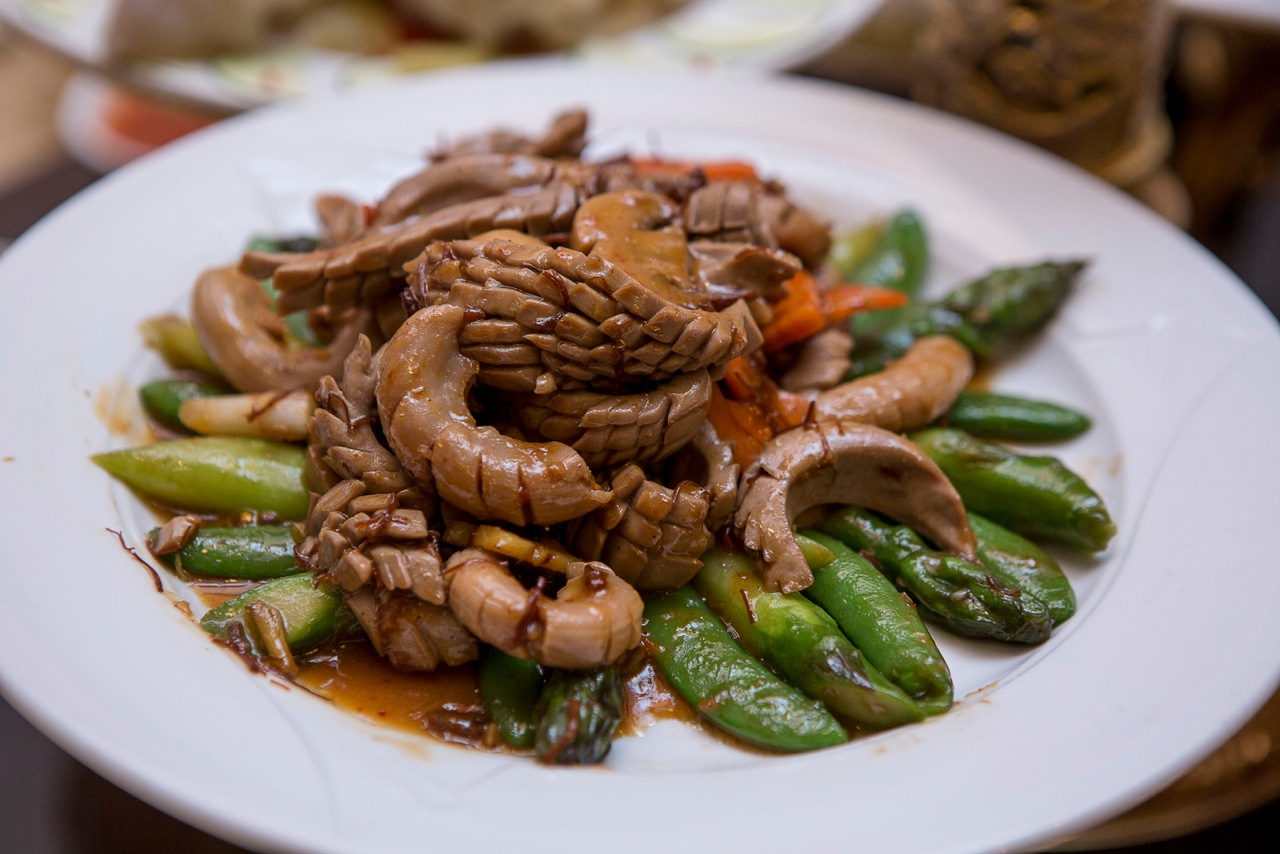
STIR-FRIED PIG’S INNARDS (同气连枝). Pig’s innards are often used in Cantonese cuisine. Cantonese chefs are renowned for turning cheap and often discarded meat into exquisite dishes through the clever use of cooking technique and sauces. Here, pig’s fallopian tubes and kidneys are prepared and quick-fried.  This dish often serves as an accompaniment for wines.

SOUP


BRAISED SUPERIOR SHARK’S FIN (凤凰纯大鲍翅) This dish made its appearance in the Ming Dynasty, when the Chinese empire was “open” and still reaching out to the rest of the world. Guangzhou and Fuxian were the principal ports-of-call, and both cities enjoyed prosperity and decadent standards of living brought about by trade. Shark’s fin was the dish to showcase your skills if you were a top Cantonese chef. It was also a symbol of luxury. The thick broth was prepared with chicken, pork, and Chinese ham, and the shark’s fin was then braised for hours in this rich broth.

MAINS

STEAMED GROUPER WITH PRAWN PASTE (麒麟蒸大石班鱼) is a flamboyant way to display the chef’s cleaver and cooking skills. The fish is completely deboned, and its flesh scrapped from the skin and made into paste with prawn, scallop and water chestnut. The paste is then spread on the fish skin and steamed. This dish was usually served at formal Chinese dinners.

BRAISED TURTLE WITH CHESTNUT WRAPPED IN CAUL OIL (粟子纲油红烧山瑞) is a Chinese delicacy served especially at birthday feasts as the turtle is a Chinese symbol of longevity. Chestnut, dried shitake mushroom, and roast pork are added to enhance the turtle meat. The mixture is then wrapped in caul oil to moisten it during braising.

BRAISED PORK BELLY WITH YAM (三水香竽扣肉配荷叶包) is a versatile Chinese dish served at home as well as at fine dining restaurants. The key ingredients are simple -- just pork belly and yam -- but it takes multiple cooking processes to prepare this dish. It was believed that Fujian produced the best yam in southern China.
 
Left - top & bottom: Braised Turtle with Chestnut wrapped in Caul Oil; Right: Brasied Pork Belly with Yam
DEEP-FRIED NOODLE IN DUAL SAUCES (鸿图窝面) While yee mee is never served “dry”, neither would it have been deemed proper to serve it in soup in this instance. So the chef created a light broth to “soak” the noodle in, and poured a layer of thickened gravy over it to create a visually appealing dish.

DESSERT

LOHAN PAPAYA SOUP (万寿果甜汤) There was a time that the lohan was considered an expensive herb used as a soother for throats and a remedy for coughs. The base of this dessert comes from brewing lohan and papaya with other ingredients.


RED STAR RESTAURANT
54 Chin Swee Road
#07-23
Singapore 160054
Telephone:   65-6532 5266

Photography by Mark Ong