Showing posts with label Personalities. Show all posts

Tuesday, 31 March 2015

1960s Chinatown breakfast -- a living portrait in Singapore


Having breakfast in Chinatown in the 1960s was like eating with a large extended family. 

It was a sea of familiar faces: the hawkers were mostly people from the same neighbourhood; some, in fact, were one’s own relatives. But mostly, the hawkers were housewives or retirees seeking to supplement meager incomes peddling food on the streets at a time when legislations like the hawker license were unheard of.

This state of semi-anarchy resulted in the explosive proliferation of our street food as we know it today. A shantytown of makeshift stalls sprang up in Chinatown, in the lanes and 5-foot-ways that cut through the ranks of 3- and 5-storey prewar shophouses and Art Deco-style SIT buildings that packed the area between Kreta Ayer Road and Temple Street.

While the shops and businesses occupied the street level, people, including many hawkers, lived upstairs. Living conditions in the upper storeys of shophouses were horrific – even slum-like -- by today’s standards. Individual and even multiple families occupied tiny, dark, airless cubicles. The few toilets there were, the kitchen, and corridors, were shared by everyone. Women cooked into the wee hours in the cramped, often single, kitchen; and there was not an ounce of privacy. The burdens of living were relieved by simple joys like sewing and gossip and plenty of community spirit.

One of these pleasures was food. Different dialect groups would congregate and live in distinct portions of Chinatown, giving rise to clan and other communal associations specific to each ethnicity. In particular, the arriving immigrants brought the food and culinary traditions of their homelands and planted them in Chinatown.

By the break of dawn around 6 am, hawkers could be seen stacking up crates and boxes along the already crowded streets and under the staircases, often assisted by members of their family. Wooden trays would be perched on top of the crates as serving counters and ‘dining tables’. Other hawkers would peddle their food in 3-wheel carts, trundling them through the alleyways of Chinatown. Food would literally ‘fly off the shelves’, and by 10 o’clock the hawkers would wrap up, clean up and head home to the rest of the day’s chores. The next day it begins anew.

The hawkers of Chinatown embodied the diversity of cultural histories and economic realities to be found within that half-square-mile of seething humanity. In fact the personal story can sometimes be as piquant and fascinating as the flavours on the plate; here are some faces and their foods that I remember.

FRIED DUMPLING (炸粽子)
Yong Jie  (容姐)-- as she was known in the neighbourhood -- came from Shenzhen after WWII. Rumour had it that she fled with bags of money stolen from her husband, then squandered the loot in Singapore and was reduced to earning a living selling fried dumplings. Yong Jie had adopted a girl -- a common practice among single women of the day – in the hope of securing some care for herself in old age. 


Each morning Yong Jie and her daughter would set up a stall at the end of Sago Street, next to Keong Saik Street – the spot no longer exists, having being replaced by Chinatown Complex. She would set a wooden tray, about the size of a school desktop, on a crate. Next to it would be a charcoal stove supporting a wok of boiling oil. She made Fried Dumpling at 10 cents each; in fact, she was the only person I ever knew in Singapore who sold this particular food.

Fried Dumpling was an old Hakka creation that has disappeared even from China. It used to be called “za” dumpling (); since “za” sounded like “fried () in the Hakka dialect. It gradually came to be called “zha” dumpling (), as “zha” was the actual word for “fried” in Hakka.

The version I encountered in mainland China was a dumpling pan-fried until crispy and then eaten dipped in sugar, salt, or a ginger/garlic dip. Yong Jie perhaps took her cue from the Goreng Pisang man, as her dumpling was dipped in batter and fried, and eaten with five-spice salt.
 
Add caption
PENNYWORT DRINK image by Mark Ong
Ku Po (姑婆) was a retired Samsui woman who shared a cramped 20-sq-m room with her daughter’s family of six. Every morning she would head to a nearby ice-factory with two thermos flasks. She would line the bottom of the flasks with newspaper-wrapped dry ice, and fill the rest of the space with ice popsicles. She then roamed the streets selling the popsicles to young children.

Past noon Ku Po would head home; along the way she would stop at the market to pick up some pennyworts and pickled lemons. Her grandchildren would wait eagerly for her at home, hoping for leftover ice popsicles; the family then gathers to pluck, wash and pound the pennywort leaves. Ku Po’s daughter then squeezes the pulp for the juice.

Come evening, Ku Po and one of her grandchildren would carry a container filled with pennywort juice to the cross-junction of Banda Street and Sago Lane. At one of the busiest spots in Chinatown, she sets up a makeshift stall selling iced pennywort and pickled lemon juices.

The customers to her stall would probably be people headed to the funeral parlours at nearby Sago Lane; or they would be kids; or labourers who worked at the construction sites and warehouses.  Pennywort juice was one of the cheapest ways, it was believed, to ‘cool’ the body and purge it of toxins generated by the hot sun.  The pulp of the pennywort, too, had its remedial effects, being commonly applied to cuts, swollen joints, and even acne.

As pennywort juice had a unique intense rawness to its taste, heavy syrup was added to ‘sweeten’ it, and a glass went for 5 cents.


DRIED COD PORRIDGE image by Mark Ong
Mui Ku (梅姑) was a retired ‘ah mah’ from Shunde who lived in a small room with a roommate, a ‘sister’ from the same province in China.  The two old women had accumulated some savings from their days working as ‘ah mahs’; but to help stretch it, they prepared a Shunde recipe to sell -- dried cod and peanut porridge.

Dried cod was a cheap source of umami in southern China, where Mui Ku came from. It was usually grilled so that its flavour would come through completely when the cod was used as base for stock. Sometimes the dried cod would be blended into powder as part of the marinade in wonton and meat loaves.

Mui Ku would wake up at 4 am to set up the charcoal stove. She would grill the dried cod and hammer it with a stone pestle; meanwhile the porridge was set to boil for the next two hours. The pulverized pieces of dried cod, as well as peanuts, would be added to the porridge. She would then fry noodles in batches and store them in aluminium pots.

Mui Ku’s partner would have already set up the stall made up of wooden crates under the staircase of the shophouse where they lived. At 6 am, Mui Ku would man the stall while her partner delivered orders to nearby residents on a round metal tray. They charged 10 cents for a bowl of porridge and delivery was free.

By afternoon, their business day done, the 2 friends would go around Chinatown scavenging for cardboard to sell as scrap.


SERIKAYA
It was rare for a Eurasian family to live in Chinatown in those days. Auntie Rose, along with her family, was considered ‘rich’ by the neighbourhood because her husband worked at a bank. However, Auntie Rose would bake cakes and kuehs in her spare time to earn some extra pocket money. The neighbours and friends would come to her house next day to collect their orders. Apart from butter cake and Swiss roll, I remember most vividly her Serikaya.

Serikaya is nearly impossible to find today, and most Singaporeans have never heard of it. Even in the early years, it was only well-to-do Eurasian and Peranakan households that prepared Serikaya, and it was usually for their own consumption. Serikaya is a custard of egg, coconut milk and sugar, with pandan leaves for a delicate fragrance – and it has always been laborious to make.

Serikaya was usually eaten with toast or as accompaniment to steamed glutinous rice. Even back then, Auntie Rose hardly made this confection, as Serikaya didn’t have a long shelf life and refrigerators weren’t that common.

PICKLED CRABS
Mr Chua did not operate a stall but he supplied ingredients to hawkers in Chinatown. He worked in a kelong and so was often away for days at a time. His family looked forward to his homecomings, as he would bring fresh sea-catch such as groupers, snappers -- and even a tiny crocodile once. After the family has had their pick, the excess would be sold to the neighhourhood hawkers at a discounted price, and one item in particular was much sought after: pickled mangrove crabs.

The family would pickle these mangrove crabs, or ‘wa kee’, in bottles and distribute them to Teochew porridge stalls around Ellenbourgh Market. The wa kee were small crabs that inhabited the mangrove swamps feeding on the propagules, or buds, of the mangrove plant. They emerged from their mud-burrows at dusk and were known to climb as high as 6m up a tree to forage. To harvest the crabs a net was held at the base of the tree and a long stick used to scare or dislodge them, dropping them into the net.

The Chuas would soak the crabs in soy sauce or vinegar, together with garlic, chilli and coriander leaves. The Teochew in particular considered pickled wa kee a delicacy and relished them with porridge.

STUFFED INTESTINES image by Mark Ong
The Lees were Hakka. Mr Lee held an administrative post at the bank and so the family could afford a whole shophouse storey to itself. Mrs Lee was a good cook and many a time the aroma of her cooking would fill the area around her kitchen.

On festive seasons, Mrs Lee would reserve 'ikan parang' (wolf herring) from the fishmonger and set up a mini-factory in her hallway. She would scrape the flesh from the fish and beat it into paste. Her 3 children would stuff this fish paste into various vegetables, churning out ‘yong tau foo’ which would then be delivered in boxes to families nearby who had preordered them for dinner.

There was a particular dish that only a true-blue Hakka would order from Mrs Lee -- stuffed egg custard in animal intestine. Its preparation was, like many traditional dishes, laborious: the intestines had to be cleaned and flushed with water. Eggs would be whisked with meat stock and poured into the intestines, which then had to be slow-boiled in simmering water to avoid the intestines bursting. Finally, the cooked intestines were cut into 1.5 cm-thick slices and eaten with a dip or cooked in a broth.

Note: This article first appeared in ZbBz on September 2014 as 'The Flavour of a Life'.

Sunday, 28 September 2014

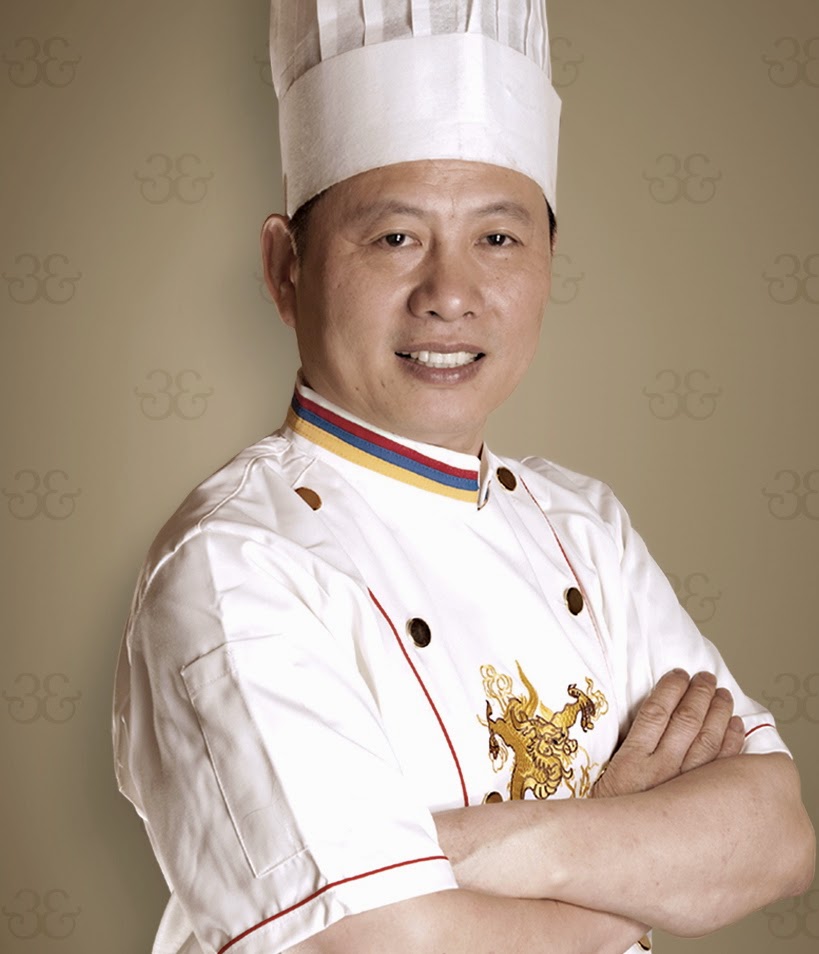
The Man Behind the Michelin-Starred Hong Zhou Restaurant


It was elite credentials by any standard – to be among the first batch of chefs awarded the country’s highest culinary honor, the National Grade of China; and to be recognized as one of China’s 8 most illustrious chefs. But these were not Chef Wu’s, they were his dad’s.

Chef Wu Rui Kang knew he had a tough act to follow. And so he became the first and only Michelin-starred chef of Hangzhou cuisine in the world.
 Chef Wu’s entry into Michelin fame was dramatic. His restaurant’s non-inclusion in the inaugural Michelin Guide Hong Kong 2008 was greeted with howls of disbelief and derision from local food magazines and netizens. The credentials of the Michelin arbiters were questioned, in particular their knowledge of the Chinese food scene in Hong Kong. The following year came the much-deserved nod from Michelin for the Chef, with a one-star ranking.

In fact Chef Wu’s sterling career was hardly heralded. After graduation from university he held a senior post in the Chinese civil service, from which he left to start a small restaurant in Hangzhou. As business grew, he decided to shift his base to Hong Kong, where his father was working at that time as executive chef for a renowned Hangzhou-style restaurant.  Chef Wu opened the Hong Zhou Restaurant in 2006.

While the Chef is, as we have seen, highly esteemed by food circles in Hong Kong, his is an audience that is ardent, initiated, and “focused”. Hangzhou cuisine, while increasingly revered in China, is still received with ambivalence in Hong Kong where Cantonese and Shanghai food reign supreme. But the Chef is patient and resolute.

Tweaking his flavors to suit the local palate is something he has stood against from the start, while the use of air-flown ingredients all the way from Hangzhou is a practice he has always insisted on. Such rigorous measures -- and not half-efforts and compromises -- are what he believes authenticity and reputations are built upon, and what he believes will ultimately win him a large audience for his beloved cuisine. Now he has the star to prove it.

But what makes a great chef? Chef Wu proposes a combination of assets: kitchen ethics, intelligence, and innate gifts. Kitchen ethics implies respect and humility, especially before teacher or master, he says, and the willingness to give your best in everything from cooking to personal hygiene. In short: attitude.


Intelligence is the drive for technical mastery. Chef Wu lists essential areas such as kitchen skills, cost control, and financial/business acumen. Finally, innate talent and passion is a factor. But, stressed the Chef, it must be coupled with a lot of hard work.
Only then will innate gifts make a difference, and raise the aspiring chef above all the others to greatness.


Hong Zhou Restaurant
1/F Chinachem Johnston Plaza
178-186 Johnston Road, Wanchai, Hong Kong
Tel: +852 2591 1898

Wednesday, 22 May 2013

The Jumping Table - A Golden Performance By Two Legends


In my wildest dreams, I couldn’t have imagined this.

Two living legends of early Singapore cuisine – Masterchefs Sin Leong and Hooi Kok Wai – graciously took the time to make my dream come true four nights ago. By recreating long-forgotten dishes of the 1950s and 60s, they brought back some of the most cherished childhood memories of mine and of the 30 friends who shared the dinner table with me.

In fact, it was the second time the two maestros had done this. The first was a gorgeous rendition of the classic Cantonese wedding feast on last January. This time around, they had prepared a tribute to the Golden Era of Cantonese cuisine, featuring eight rare dishes.

Like all “golden eras” it’s hard to pin it down to precise dates, but the flowering of Cantonese cuisine, as we know it, probably began in the 1920s. It was a time of economic and political turmoil -- and extremes. The rich wallowed in luxury and excess, while the poor starved and left China in the millions to seek better lives elsewhere.

In southern China, Guangzhou became the epicenter of life: the place to wine and dine and live it up. Four great restaurants dominated the city -- Da San Yuan (大三元), Wen Yuan (文园), Nan Yuan (南园), and Xi Yuan (西园). They created dishes that lived on in Cantonese restaurant menus all over the world. The cooking styles and techniques they pioneered are the principal stock-in-trades of any respectable Cantonese chef today. And while catering to the lavish tastes of the era, they established the cult of the so-called “Four Treasures of Cantonese Cuisine” -- dried abalone, sea cucumber, shark’s fin and fish maw – and raised it to mythic status within Cantonese fine cooking.

Braised superior shark’s fin (六十元大裙翅) was the calling card of Da San Yuan. In the 1930s, to eat a bowl of this dish would cost the diner the equivalent of 14 baskets of rice padi.  To produce 2 liters of its stock required 15 kg of meat and Chinese ham, and four hours of brewing. Only the elite could afford it, and the dish remained but a dream to the masses.

Stuffed Chicken (江南百花鸡), the signature dish of Wen Yuan, was a display of virtuosic skill. The chicken was gutted leaving just the skin intact. A mixture of prawn and lard paste, about 2.5-cm thick, was pressed onto the skin, then steamed, cut and rearranged on a plate. Thick gravy made of superior broth was poured over the “chicken” just before serving. How expertly the cleaver was handled, and the preparation of the prawn paste, became the measures of the dish’s success.

Nan Yuan’s gift to posterity was its braised sliced abalone (红烧大纲鲍片). Each abalone was still alive when dried, a process that created a “soft” center that was unique for its time. The braised abalone, weighing some 200 grams apiece, would be sliced thinly before serving. The thick gravy that coated each abalone slice would, if perfectly made, leave the plate dry after the whole abalone had been consumed.

Xi Yuan was the only vegetarian restaurant in the prestigious list of four. Most matriarchs and wives among the rich in those days were devoted Buddhists, hence vegetarian cuisine was popular. The ingredients used in the vegetarian dishes of Xi Yuan were painstakingly sourced from all over China, especially the amazing arrays of mushroom, fungi and vegetable. One such famous dish was Ding Wu Vegetable (鼎湖上素), where three of the most expensive mushrooms and six types of fungi were used in its preparation.

After WWII, many Cantonese restaurants on the mainland were taken over by the Communist state. The leading chefs fled, to Hong Kong first and then the rest of the world. Many arrived in Singapore, and as a result the chefs in the top Singaporean restaurants of the 40s and 50s were often trained under these newly arrived Guangzhou immigrants. Skills were taught, absorbed and passed on.

In Singapore, Cantonese food flourished. Local masters wove local ingredients and techniques into the culinary melting pot. Alongside old dishes, new homegrown ones emerged. Game meat was the rage in the 60s and civet cat, anteater and bat became a common sight in restaurants. At the same time, road-side “cze char” stalls made sweet sour pork, claypot liver, and black-bean pork ribs with bitter gourd the popular standards of the working class. And with the arrival of “nouvelle” style, Cantonese cooking entered a new stage of evolution, which continues to the present day.

But for tonight, the gilded age of Cantonese gastronomy lives! We were one lucky group.

Duo jie, maestros!

APPETISERS


DUCK WEB STUFFED WITH PRAWN PASTE (掌上明珠) was a popular dish in local Chinese fine dining in the 60s. As a kid, I remember watching a wizened old lady sit in front of Ming Kee, a famous restaurant in Chinatown. She would use her teeth to “pick” out the bones from the duck web that would be used in the dish! Prawn paste was then shaped into a ball, placed on top of the web and steamed. The resulting dish would resemble a human palm holding a large white pearl, hence the apt Chinese name.

Crystal Pork Trotter (白雪猪手) requires multiple repetitions of boiling and soaking in ice water in order to achieve the jade-like crunchy texture of the meat. The trotter is then soaked in white vinegar, sugar and wine.

ROAST PORK/LARD COIN (金钱烤鸡). The fat is pickled in sugar and Chinese rose wine for at least a few days, turning it translucent and crunchy. This fat is also used in other Cantonese classics such as Lard Bun, and Chicken Biscuit. In this dish, pork, crystal lard, and chicken liver are shaped into round “coins”, skewered and roasted. Tonight, chicken liver had been omitted.


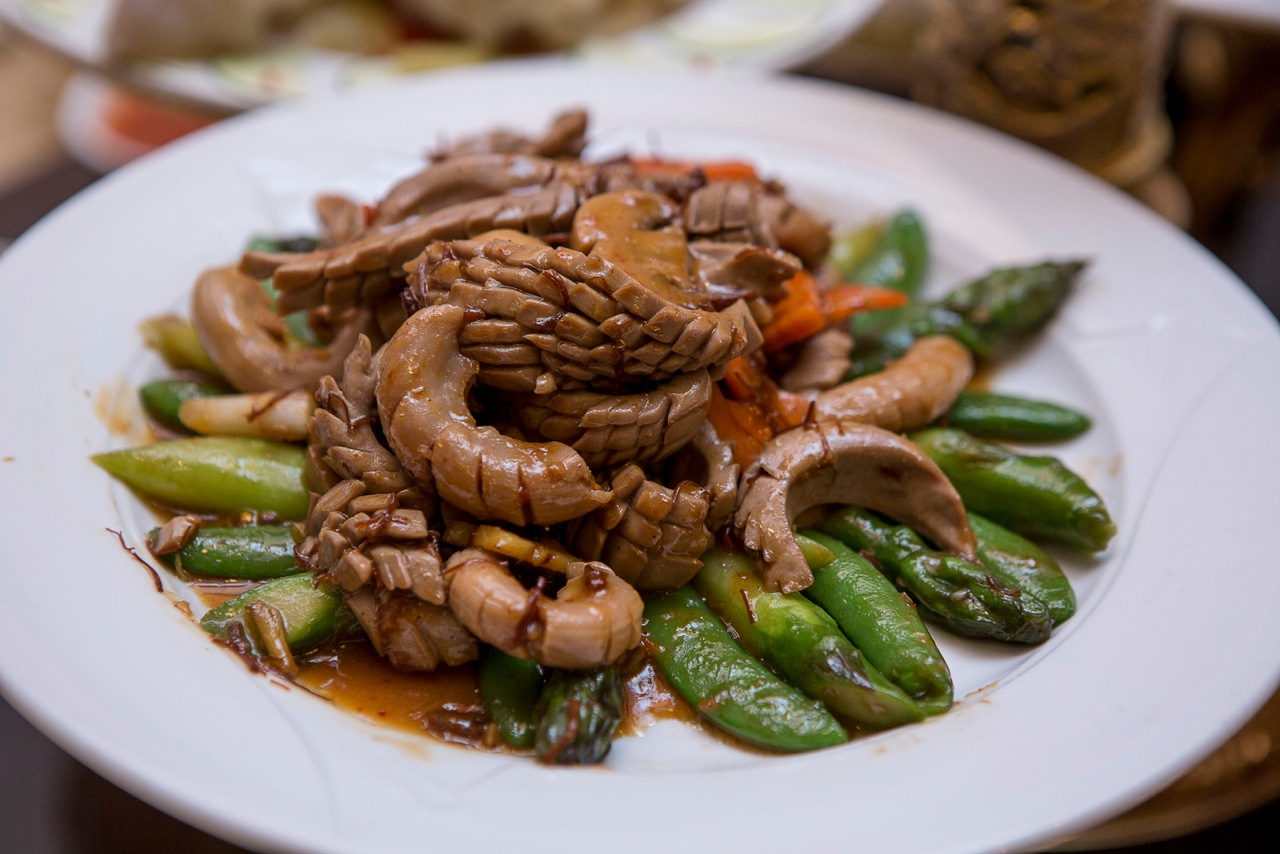
STIR-FRIED PIG’S INNARDS (同气连枝). Pig’s innards are often used in Cantonese cuisine. Cantonese chefs are renowned for turning cheap and often discarded meat into exquisite dishes through the clever use of cooking technique and sauces. Here, pig’s fallopian tubes and kidneys are prepared and quick-fried.  This dish often serves as an accompaniment for wines.

SOUP


BRAISED SUPERIOR SHARK’S FIN (凤凰纯大鲍翅) This dish made its appearance in the Ming Dynasty, when the Chinese empire was “open” and still reaching out to the rest of the world. Guangzhou and Fuxian were the principal ports-of-call, and both cities enjoyed prosperity and decadent standards of living brought about by trade. Shark’s fin was the dish to showcase your skills if you were a top Cantonese chef. It was also a symbol of luxury. The thick broth was prepared with chicken, pork, and Chinese ham, and the shark’s fin was then braised for hours in this rich broth.

MAINS

STEAMED GROUPER WITH PRAWN PASTE (麒麟蒸大石班鱼) is a flamboyant way to display the chef’s cleaver and cooking skills. The fish is completely deboned, and its flesh scrapped from the skin and made into paste with prawn, scallop and water chestnut. The paste is then spread on the fish skin and steamed. This dish was usually served at formal Chinese dinners.

BRAISED TURTLE WITH CHESTNUT WRAPPED IN CAUL OIL (粟子纲油红烧山瑞) is a Chinese delicacy served especially at birthday feasts as the turtle is a Chinese symbol of longevity. Chestnut, dried shitake mushroom, and roast pork are added to enhance the turtle meat. The mixture is then wrapped in caul oil to moisten it during braising.

BRAISED PORK BELLY WITH YAM (三水香竽扣肉配荷叶包) is a versatile Chinese dish served at home as well as at fine dining restaurants. The key ingredients are simple -- just pork belly and yam -- but it takes multiple cooking processes to prepare this dish. It was believed that Fujian produced the best yam in southern China.
 
Left - top & bottom: Braised Turtle with Chestnut wrapped in Caul Oil; Right: Brasied Pork Belly with Yam
DEEP-FRIED NOODLE IN DUAL SAUCES (鸿图窝面) While yee mee is never served “dry”, neither would it have been deemed proper to serve it in soup in this instance. So the chef created a light broth to “soak” the noodle in, and poured a layer of thickened gravy over it to create a visually appealing dish.

DESSERT

LOHAN PAPAYA SOUP (万寿果甜汤) There was a time that the lohan was considered an expensive herb used as a soother for throats and a remedy for coughs. The base of this dessert comes from brewing lohan and papaya with other ingredients.


RED STAR RESTAURANT
54 Chin Swee Road
#07-23
Singapore 160054
Telephone:   65-6532 5266

Photography by Mark Ong