It’s
strange but when life is tough and spending power low, people get more creative
in amortizing their money. When I was young, nothing in my household went to
waste. Books were passed on to younger siblings, or, in my case, as I was an
only kid, given to relatives and friends. I would think twice about indulging
in a 2nd pair of jeans, and especially, about throwing away
perfectly edible food.
I
remember vividly how my family would slaughter and apportion a chicken. The best
parts of the torso would be used for the main dish, while sub-grade pieces and
offal would be set aside to become ingredients for another dish. The bones and
feet would be tossed into the stockpot, or, as in this instance, made into a
tasty and wonderful dish for nibbling.
Duck
wings and duck webs were often deemed suitable only for making stock, yet when stewed,
their taste was sublime. I would often cook these underrated pieces with
chicken feet or pig belly, and when the dish was kept overnight, it tasted even
better. Here’s the recipe I used.
Duck
Wing & Chicken Feet Stew
Duck
wing10,
cut into 2
Chicken
feet10, whole
Dried
shitake10,
soak in water for 20 mins. Drain and keep the water
Oil2
tbsp. preferably lard
Garlic12,
whole
Sugar½ tbsp
Oyster
sauce2 tbsp
White
peppera dash
Japanese
cooking wine½ cup
Chicken
stock1 cup
Salt½ tsp
Dark
soy sauce1 tbsp
Marinade:
Oyster
sauce½ tbsp
Ginger
juice½ tsp
Japanese
cooking wine½ tsp
Light
soy sauce¼ tsp
Method:
Marinade duck wing and
chicken feet for 1 hour. Drain.
Heat oil. Gently fry garlic
until golden brown. Remove and drain. Set aside.
Saute mushroom for 5 minutes
in low heat. Add sugar at mid-point.
Increase heat to maximum,
sauté meat until it is golden brown.
Add oyster sauce and white
pepper, and continue to fry for one minute at high heat.
Pour Japanese cooking wine
and let the spirit evaporate.
Add chicken stock and cover
the pot.Simmer for 45 minutes or
until the meat is tender. Don’t overcook the meat.
Add garlic and simmer for
another 10 minutes with the lid removed.
I was
introduced to Tian Qi, a Chinese herb, when I hit puberty. This was a period
where I would, literally, grow by centimeters when I hit the sack. Yes, we
humans only grow when we sleep. And this herb was believed to help the body to
generate and regenerate new cells for growth.
There was
a legend about how Tian Qi was discovered. A monkey was once badly injured by a
villager. After several days however, the monkey was seen to have made great
progress in recovery. The villager decided to trail the monkey and spied it
digging some roots to eat. After the monkey left, he dug up the root and took
it home. And that was how Tian Qi came to be a frequently prescribed medicine
among traditional Chinese physicians to this day.
The herb
is usually used in conjunction with Ginseng, because it is believed that Ginseng
is great for improving “qi” or energy while Tian Qi delivers benefits to the
blood and bones.
I wasn’t
the only one taking this herb; my pets loved it too. I would grind the herb
into powder and mix it into their food, and I was convinced that Tian Qi helped
heal my animals’ cuts and wounds faster.
As I grew
older, I would often boil the herb according to the recipe below. Tian Qi is
also known to stabilize blood pressure and prevent stroke. I would add pork trotter and chicken feet to
further supplement the collagen in my body. Tian Qi is easily available from
Chinese medical shops.
Tian Qi & Ginseng Soup
Tian Qi (田七)10
g, sliced thinly
Ginseng(泡参)20 g, sliced thinly
Pork
trotter500 g
Chicken
feet300 g
Chicken 400 g
Honey
dates6
Chinese
yam250 g, cut into
chunks
Water4 litres
Salt2
tsp
1.Put
both Chinese herbs in a cloth bag. Secure the opening tightly.
2.Blanch
pork trotter, chicken feet and chicken for 5 minutes. Drain and rinse meat
under tap water.
3.Add
Chinese herbs, honey dates and Chinese yam in a pot of water. Bring to boil.
4.Add
meat and boil for 10 minutes. Lower heat and simmer for 2 hours.
I was
lucky to have an amah as company when I was growing up in Singapore.She was fiercely loyal, insanely protective
and cooked like a Michelin-star chef. She had come from Shunde, China, in the
1950s, as life was hard there then.
The
Shunde women who travelled to Singapore were mostly illiterate. They were
helped largely through the recommendations of friends who had come earlier, and
found work mainly as domestic help. They worked and lived with their employers,
with certain days off a month. These women came to be known affectionately as
“amah” (“mother” in Cantonese) for their devotion. An amah usually stayed with
one family for life until retirement, becoming a respected family member, and,
in some cases, a de facto matriarch.
As amahs
took a formal vow of singlehood, they remained unmarried through life. However,
they formed strong bonds with their peers, and quite commonly shared an accommodation
where they could congregate during their days off. What leisure hours they had
would be spent at the professional letter-writers who read and wrote their mail
from home in China. They would also catch up and gossip with other amahs and,
most importantly, they would cook up a Shunde feast to “cure” their homesickness.
I have
vivid memories of the amah who helped raise me. She liked to keep herself busy,
and was always casting around for things to do in the house. I remember how she
would buy cloth to make covers for everything -- furniture, appliances – and how
she used a string to meticulously take measurements and cut the cloth.
I was a
mischievous kid and always got into trouble, so she used food to distract me. Which turned out to be a good thing. I would
help her prepare snacks to be eaten while watching afternoon matinees on TV; and
it was from her, that I learned Shunde cooking. For the most recent session of
my new project, The Jumping Table, I cooked a Shunde dinner for my friends,
with dishes I ate as a child. I’ve adapted some recipes to suit the ingredients
available in Singapore -- but the techniques remain the same ones I learned
from my amah.
Cordyceps, Dried Figs &
Kumquat Drink/天地遍黄金
For the
welcome drink, dried figs, kumquat and brown sugar were boiled to extract the
sweetness. I added cordyceps 10 minutes before
the drink was ready. Cordyceps is believed to possess anticancer properties and
also acts as an anti-depressant agent.
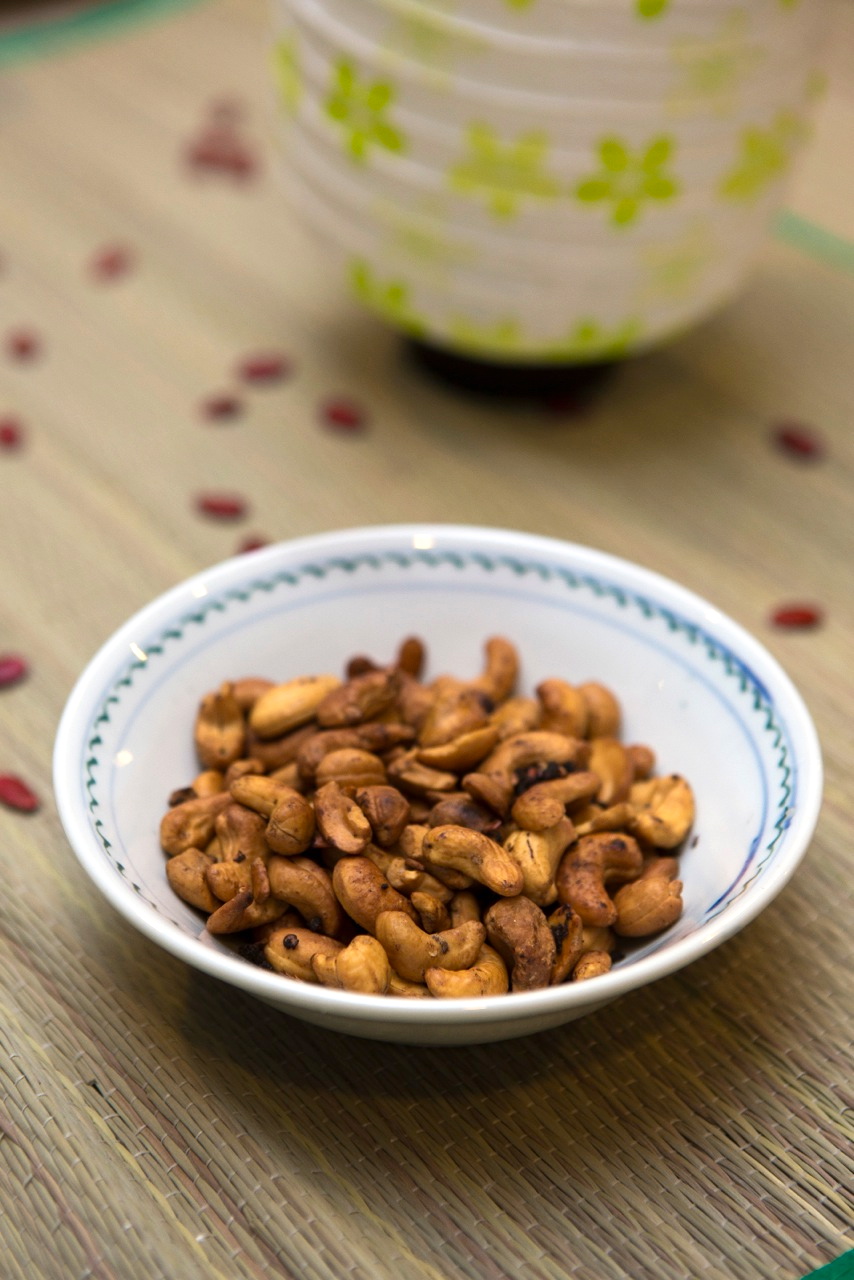
Fried Spicy Cashew Nuts/花落再重生
Fresh
cashew nuts is marinated overnight, boiled, and fried until crispy. It was a
snack for the family and visitors.
Roast Meat with Crystal
Lard/凤干金钱鸡
Curing
fat is an ancient skill, yet the knowledge to do it has mostly vanished from
Singapore. The fat, known as “bing ro”
or 冰肉 in Chinese, is cured in
sugar for days. The end result is a piece of transparent meat with a crunchy
bite. One popular use of it is as roast meat with chicken’s liver -- with each
bite, you would experience three different tastes and textures in one mouthful.
Seared Semi-dried Oyster in
Wine/意醋煎干蚝
This
method of semi-drying and preserving oysters results in oyster that is
half-juicy, yet infused with a flavor far more intense than that of fresh
oysters. The oysters would first be steamed in wine, salt and sugar. Once
cooked, pan-frying would sear the oyster. I then added some balsamic vinegar to
the remaining juice and reduced it. Finally, the oysters were tossed into the
reduction for a nice glossy finish.
Traditional Meat Roll with
Chinese Ham/古式野鸡卷
This
dish, which combines ordinary ingredients with intricate skill and technique,
has become very hard to find. By transforming simplicity into something to wow
the palate, it can be said to embody the spirit of Shunde cuisine. The meat is
thinly sliced, then marinated, steamed, and fried. To balance the taste of
lard, I have added a slice of caramelized pineapple.
Blanched Fish Soup/鱼边皮蛋汤
This
simple bowl of soup is usually served during summer. Its key ingredient is cha gua, 茶瓜 , a preserved vegetable
believed to “cool the body” during hot weather. Sadly, this ingredient is quite
neglected here. This soup is very “clean”, with a pronounced taste of fish
accentuated by cha gua and coriander. Traditionally, the Chinese carp is used,
but I have opted for ikan parang, and used the most tender cut of the fish,
located just below the dorsal fin.
Pan-fried Lotus Root Meat
Cake/顺德煎藕饼
Another
trait of Shunde style is the ability to come up with “101 ways” to cook banal
ingredients in a tasty manner. While lotus root is usually made into soup, here
it is shredded and pan-fried into a pancake. The yam in the mixture is a
secondary ingredient that offers an additional level of taste.
Steamed Pork with Pearl
Rice/蕉叶米沙肉
The
Jasmine rice that is crushed and added as an additional coating on the pork
cubes absorbs the juices and flavors of the meat. By wrapping and steaming in
banana leaf (similar to the double-boiled effect), this delicate dish offers up
the scent of lotus, the grainy texture of rice, and the succulence of meat
cooked to perfection.
Smoked Chicken in Soy
Sauce/色香太爷鸡
This
recipe was created by a late-Ching Dynasty scholar, who found himself in dire
straits in his autumn years, and cooked this chicken to earn a living. The dish
became popular, but as the term “smoked” sounded demeaning in Cantonese, the
dish’s name was later changed to reflect its creator’s official appointment at
court. While smoking was a common technique in the Zhejiang area, the Cantonese
hardly cook using this method.
Steamed Glutinous Rice with
Cured Meat/八味糯米饭
In
autumn, Shunde villagers would slaughter their animals and cure and preserve
the meat for winter. They would marinate the meat, stuff it into animal’s
intestines and hang it in the open field, where the dry North Wind cured the
meat quickly without dehydrating it too much. I cured the pork belly myself,
burying the meat in coarse salt and leaving it in the fridge for weeks. I
picked dried scallops, chicken cubes and dried shrimps – similarly colored
ingredients -- to give layers of taste, and a visually “neat” appearance to the
dish. Another ingredient was also added: Shunde’s famous preserved radish.
Steamed Guo with Preserved
Candies/芬芳竹叶果
This
dessert makes an appearance only at Chinese New Year. Traditionally, glutinous
rice cake cakes were steamed with a Ping-po leaf, which is native to Canton. I
have replaced it with bamboo leaf, which lends the dessert its own distinctive
fragrance. The stuffing is a selection of candied fruits such as tangerine,
winter melon, coconut, and lotus seeds, which comes into abundance at this time
of year.
Red Bean Soup with
Tangerine Peel/陈皮红豆沙
Although a common Cantonese dessert soup, it is
hard to find a good version of it. The beans are boiled under high heat, so
that bean and water would emulsify completely. Dried tangerine peel lends a
tangy hint. Tangerine peel is ready to be used only after a three-year period
of maturing; and the older the peel, the mellower the taste derived from it. In
fact, each year of aging seems to add another digit to its price – 50 grams of
50-year-old tangerine peel would easily fetch S$400 and above!
Credits:
Like
all great parties, it was a group effort. Special thanks to Bee Bee for the
wonderful menu design, Mark for his photographic eye, Jimmy for making my life
less stressful, Byron and Grace for the premises, and everyone for chipping in,
in one way or other. Not forgetting the two Ss for helping out in the kitchen.
Many of
us would be familiar with the black-and-white ‘amahs’ of old. We may have seen
them in our youth, or even lived with one in our household. The amahs’ devotion
to their employers is legendary; but how many of us know of the cuisine they
brought to Singapore -- the cuisine that goes by the name Shunde (pronounced
‘shun-tak’ in Cantonese).
Shunde
is located about 30 minutes by train from Guangzhou, on a site that was seabed
5000 years ago. People first settled in the area in the Nanyue Dynasty (BC 203
-110), and they came mostly from Guangdong and Guangxi in China, and Hanoi in
Vietnam.
In the
Ming Dynasty, Shunde became a prosperous agricultural city known for its
lychees and longans. It grew further economically in the Ching Dynasty, when it
became renowned as the Silk Capital of Southern China.
In
World War II, the town suffered occupation by the Japanese, and its population
-- and fortunes -- fell from 0.85 million to 0.37 million.The city’s inhabitants fled in a mass exodus
to Southeast Asia, seeking refuge and a living. The men found jobs mostly in construction
sites, while the women became the black-and-white domestic servants – the amahs
-- of the rich.
Many
famous Cantonese chefs hail from Shunde. In fact, it is believed that Shunde was
the precursor of Cantonese cuisine, as the Chinese saying suggests “食在广州,厨出凤城”,
(“Eat in Guangzhou from a Shunde kitchen”). Shunde traditional cooking employs
diverse and complicated cooking techniques. In the hands of the frugal Shunde
people, these skills and techniques have helped to transform mundane
ingredients into dishes fit for a king.