Showing posts with label The Jumping Table. Show all posts

Wednesday, 22 May 2013

The Jumping Table - A Golden Performance By Two Legends


In my wildest dreams, I couldn’t have imagined this.

Two living legends of early Singapore cuisine – Masterchefs Sin Leong and Hooi Kok Wai – graciously took the time to make my dream come true four nights ago. By recreating long-forgotten dishes of the 1950s and 60s, they brought back some of the most cherished childhood memories of mine and of the 30 friends who shared the dinner table with me.

In fact, it was the second time the two maestros had done this. The first was a gorgeous rendition of the classic Cantonese wedding feast on last January. This time around, they had prepared a tribute to the Golden Era of Cantonese cuisine, featuring eight rare dishes.

Like all “golden eras” it’s hard to pin it down to precise dates, but the flowering of Cantonese cuisine, as we know it, probably began in the 1920s. It was a time of economic and political turmoil -- and extremes. The rich wallowed in luxury and excess, while the poor starved and left China in the millions to seek better lives elsewhere.

In southern China, Guangzhou became the epicenter of life: the place to wine and dine and live it up. Four great restaurants dominated the city -- Da San Yuan (大三元), Wen Yuan (文园), Nan Yuan (南园), and Xi Yuan (西园). They created dishes that lived on in Cantonese restaurant menus all over the world. The cooking styles and techniques they pioneered are the principal stock-in-trades of any respectable Cantonese chef today. And while catering to the lavish tastes of the era, they established the cult of the so-called “Four Treasures of Cantonese Cuisine” -- dried abalone, sea cucumber, shark’s fin and fish maw – and raised it to mythic status within Cantonese fine cooking.

Braised superior shark’s fin (六十元大裙翅) was the calling card of Da San Yuan. In the 1930s, to eat a bowl of this dish would cost the diner the equivalent of 14 baskets of rice padi.  To produce 2 liters of its stock required 15 kg of meat and Chinese ham, and four hours of brewing. Only the elite could afford it, and the dish remained but a dream to the masses.

Stuffed Chicken (江南百花鸡), the signature dish of Wen Yuan, was a display of virtuosic skill. The chicken was gutted leaving just the skin intact. A mixture of prawn and lard paste, about 2.5-cm thick, was pressed onto the skin, then steamed, cut and rearranged on a plate. Thick gravy made of superior broth was poured over the “chicken” just before serving. How expertly the cleaver was handled, and the preparation of the prawn paste, became the measures of the dish’s success.

Nan Yuan’s gift to posterity was its braised sliced abalone (红烧大纲鲍片). Each abalone was still alive when dried, a process that created a “soft” center that was unique for its time. The braised abalone, weighing some 200 grams apiece, would be sliced thinly before serving. The thick gravy that coated each abalone slice would, if perfectly made, leave the plate dry after the whole abalone had been consumed.

Xi Yuan was the only vegetarian restaurant in the prestigious list of four. Most matriarchs and wives among the rich in those days were devoted Buddhists, hence vegetarian cuisine was popular. The ingredients used in the vegetarian dishes of Xi Yuan were painstakingly sourced from all over China, especially the amazing arrays of mushroom, fungi and vegetable. One such famous dish was Ding Wu Vegetable (鼎湖上素), where three of the most expensive mushrooms and six types of fungi were used in its preparation.

After WWII, many Cantonese restaurants on the mainland were taken over by the Communist state. The leading chefs fled, to Hong Kong first and then the rest of the world. Many arrived in Singapore, and as a result the chefs in the top Singaporean restaurants of the 40s and 50s were often trained under these newly arrived Guangzhou immigrants. Skills were taught, absorbed and passed on.

In Singapore, Cantonese food flourished. Local masters wove local ingredients and techniques into the culinary melting pot. Alongside old dishes, new homegrown ones emerged. Game meat was the rage in the 60s and civet cat, anteater and bat became a common sight in restaurants. At the same time, road-side “cze char” stalls made sweet sour pork, claypot liver, and black-bean pork ribs with bitter gourd the popular standards of the working class. And with the arrival of “nouvelle” style, Cantonese cooking entered a new stage of evolution, which continues to the present day.

But for tonight, the gilded age of Cantonese gastronomy lives! We were one lucky group.

Duo jie, maestros!

APPETISERS


DUCK WEB STUFFED WITH PRAWN PASTE (掌上明珠) was a popular dish in local Chinese fine dining in the 60s. As a kid, I remember watching a wizened old lady sit in front of Ming Kee, a famous restaurant in Chinatown. She would use her teeth to “pick” out the bones from the duck web that would be used in the dish! Prawn paste was then shaped into a ball, placed on top of the web and steamed. The resulting dish would resemble a human palm holding a large white pearl, hence the apt Chinese name.

Crystal Pork Trotter (白雪猪手) requires multiple repetitions of boiling and soaking in ice water in order to achieve the jade-like crunchy texture of the meat. The trotter is then soaked in white vinegar, sugar and wine.

ROAST PORK/LARD COIN (金钱烤鸡). The fat is pickled in sugar and Chinese rose wine for at least a few days, turning it translucent and crunchy. This fat is also used in other Cantonese classics such as Lard Bun, and Chicken Biscuit. In this dish, pork, crystal lard, and chicken liver are shaped into round “coins”, skewered and roasted. Tonight, chicken liver had been omitted.
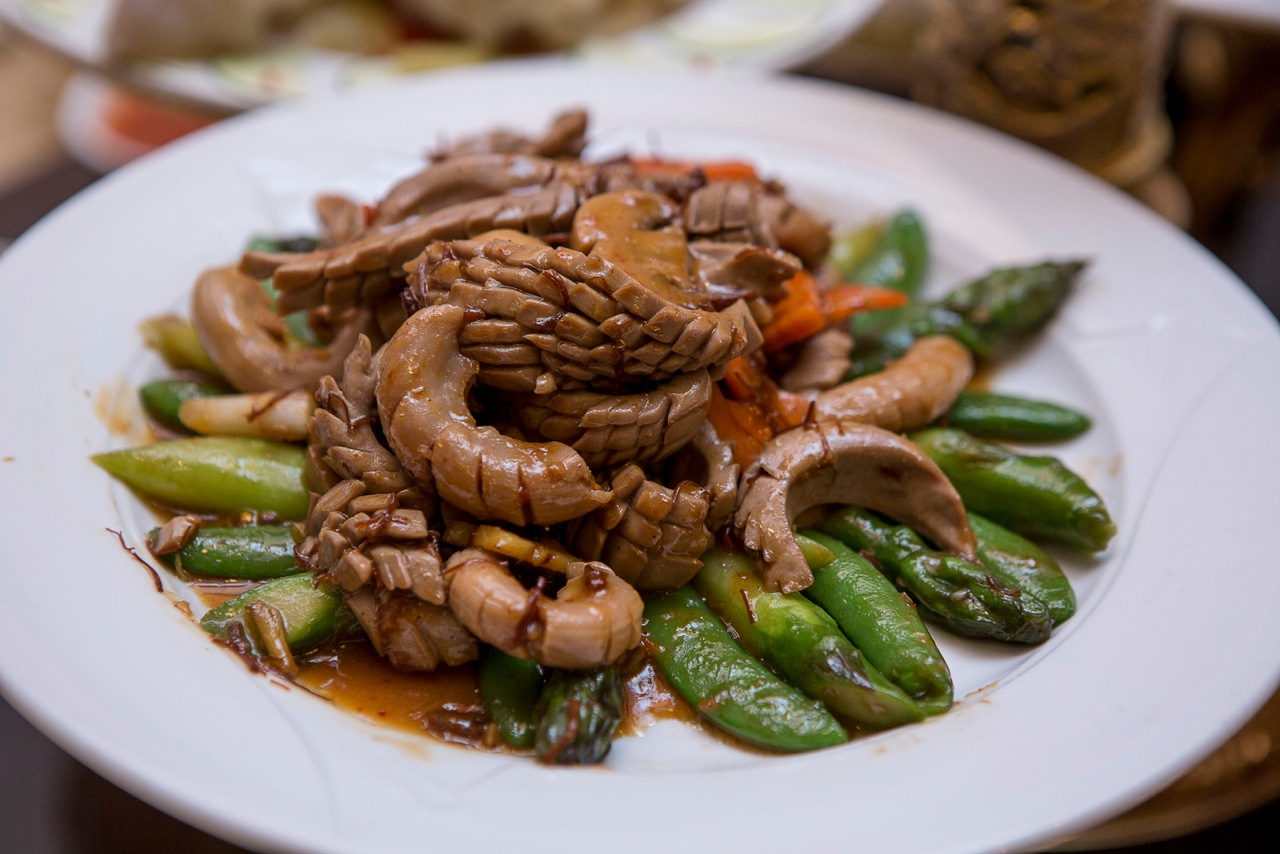

STIR-FRIED PIG’S INNARDS (同气连枝). Pig’s innards are often used in Cantonese cuisine. Cantonese chefs are renowned for turning cheap and often discarded meat into exquisite dishes through the clever use of cooking technique and sauces. Here, pig’s fallopian tubes and kidneys are prepared and quick-fried.  This dish often serves as an accompaniment for wines.

SOUP


BRAISED SUPERIOR SHARK’S FIN (凤凰纯大鲍翅) This dish made its appearance in the Ming Dynasty, when the Chinese empire was “open” and still reaching out to the rest of the world. Guangzhou and Fuxian were the principal ports-of-call, and both cities enjoyed prosperity and decadent standards of living brought about by trade. Shark’s fin was the dish to showcase your skills if you were a top Cantonese chef. It was also a symbol of luxury. The thick broth was prepared with chicken, pork, and Chinese ham, and the shark’s fin was then braised for hours in this rich broth.

MAINS

STEAMED GROUPER WITH PRAWN PASTE (麒麟蒸大石班鱼) is a flamboyant way to display the chef’s cleaver and cooking skills. The fish is completely deboned, and its flesh scrapped from the skin and made into paste with prawn, scallop and water chestnut. The paste is then spread on the fish skin and steamed. This dish was usually served at formal Chinese dinners.

BRAISED TURTLE WITH CHESTNUT WRAPPED IN CAUL OIL (粟子纲油红烧山瑞) is a Chinese delicacy served especially at birthday feasts as the turtle is a Chinese symbol of longevity. Chestnut, dried shitake mushroom, and roast pork are added to enhance the turtle meat. The mixture is then wrapped in caul oil to moisten it during braising.

BRAISED PORK BELLY WITH YAM (三水香竽扣肉配荷叶包) is a versatile Chinese dish served at home as well as at fine dining restaurants. The key ingredients are simple -- just pork belly and yam -- but it takes multiple cooking processes to prepare this dish. It was believed that Fujian produced the best yam in southern China.
 
Left - top & bottom: Braised Turtle with Chestnut wrapped in Caul Oil; Right: Brasied Pork Belly with Yam
DEEP-FRIED NOODLE IN DUAL SAUCES (鸿图窝面) While yee mee is never served “dry”, neither would it have been deemed proper to serve it in soup in this instance. So the chef created a light broth to “soak” the noodle in, and poured a layer of thickened gravy over it to create a visually appealing dish.

DESSERT

LOHAN PAPAYA SOUP (万寿果甜汤) There was a time that the lohan was considered an expensive herb used as a soother for throats and a remedy for coughs. The base of this dessert comes from brewing lohan and papaya with other ingredients.


RED STAR RESTAURANT
54 Chin Swee Road
#07-23
Singapore 160054
Telephone:   65-6532 5266

Photography by Mark Ong

Saturday, 30 March 2013

The Jumping Table – The Quintessential Malay Feast


It was only after I had lived a few years away from Singapore, that I truly appreciated having grown up in its famously multi-racial milieu. For one, Singapore has bred in me an ethnic tolerance and appreciation that I’ve come to take for granted; for another, it’s given me an omnivorous palate, and taught me the pleasures of indulging in as wide a range of cuisines as possible.


Whenever I get invited to a traditional celebration by a Malay or Indian friend, I see it as a special treat – especially when it involves food.

For me, nothing evokes the Malay love for family, friends and food, and a good time, like the ‘kenduri’. The Malay wedding features the quintessential -- and one of the most common – forms of kenduri. Who hasn’t encountered one in an HDB void deck; seen the ‘ma-chiks’ huddled together and busy with the food preparation; or smelled the delicious aromas wafting up to the upper floors, and heard the music and merrymaking?

Kenduri (pronounced ken-doo-ree) is Malay for ‘feast’. A kenduri is joyous, age-old, and versatile. Kenduris are organized to celebrate everything from weddings, circumcisions and birthdays, to anniversaries, ‘graduations’ from religious or silat (martial art) studies, festivals like Hari Raya, and even first-time pregnancies and the first haircut of a 40-day-old infant. Seems anything is fair excuse for a kenduri. And why not?


Kenduris bring people together in a riot of communal good spirits. Everybody chips in: grandmas to five-year-olds help in cooking, decorating, serving, and running errands, all in the spirit of ‘gotong royong’ (or cooperation). And everyone – guests and all – always has a fun time.

Missing the flavors of the kenduri spread that I grew up eating and loving, I approached one of my favorite chefs recently.

Bubbly and big-spirited Chef Arni used to run a well-known eatery with her husband -- Arni & Yusof -- at Far East Plaza on Scotts Road. The Arni & Yusof kitchen was originally helmed by Arni’s mother, from whom she learned the ropes and succeeded several years ago. I’ve been a patron of the stall for more than 12 years until they closed for good a few months ago. The feast that Arni prepared for my friends and I was replete with the traditional dishes and desserts of the kenduri, including mutton, nasi brani, chicken, pacheri, and in particular, kek kukus, a rarely seen caramelized cake.


A Wedding Kenduri
23 March 2013

Nasi Brani Dum

Kambing Masak Rempah Brani
Mutton in Brani Paste

Rendang Lembu
Beef Rendang


Ayam Masak Merah
Chicken in Chili and Tomato Paste


Sotong Masak Hitam
Squid in Black Ink
What got me hooked on Arni & Yusof in the first place -- sotong masak hitam for more than 12 years.
  
Udang Sambal
Sambal Prawn


Vegetables
Dalcha  / Pacheri  / Achar
Mixed Vegetable Curry with Lentils/Spicy Cooked Pineapple/Cucumber Pickle


Desserts
Kek Kukus / Bubur Kacang / Pisang
Steamed Caramelized Cake/Green Bean Dessert Porridge/Banana

All photos by Mark Ong

Friday, 1 February 2013

The Jumping Table – Recipes My Amah Taught Me


The Jumping Table – Recipes My Amah Taught Me

I was lucky to have an amah as company when I was growing up in Singapore.  She was fiercely loyal, insanely protective and cooked like a Michelin-star chef. She had come from Shunde, China, in the 1950s, as life was hard there then.

The Shunde women who travelled to Singapore were mostly illiterate. They were helped largely through the recommendations of friends who had come earlier, and found work mainly as domestic help. They worked and lived with their employers, with certain days off a month. These women came to be known affectionately as “amah” (“mother” in Cantonese) for their devotion. An amah usually stayed with one family for life until retirement, becoming a respected family member, and, in some cases, a de facto matriarch.

As amahs took a formal vow of singlehood, they remained unmarried through life. However, they formed strong bonds with their peers, and quite commonly shared an accommodation where they could congregate during their days off. What leisure hours they had would be spent at the professional letter-writers who read and wrote their mail from home in China. They would also catch up and gossip with other amahs and, most importantly, they would cook up a Shunde feast to “cure” their homesickness.

I have vivid memories of the amah who helped raise me. She liked to keep herself busy, and was always casting around for things to do in the house. I remember how she would buy cloth to make covers for everything -- furniture, appliances – and how she used a string to meticulously take measurements and cut the cloth.

I was a mischievous kid and always got into trouble, so she used food to distract me.  Which turned out to be a good thing. I would help her prepare snacks to be eaten while watching afternoon matinees on TV; and it was from her, that I learned Shunde cooking. For the most recent session of my new project, The Jumping Table, I cooked a Shunde dinner for my friends, with dishes I ate as a child. I’ve adapted some recipes to suit the ingredients available in Singapore -- but the techniques remain the same ones I learned from my amah.

Cordyceps, Dried Figs & Kumquat Drink/天地遍黄金
For the welcome drink, dried figs, kumquat and brown sugar were boiled to extract the sweetness. I added cordyceps 10 minutes before the drink was ready. Cordyceps is believed to possess anticancer properties and also acts as an anti-depressant agent.

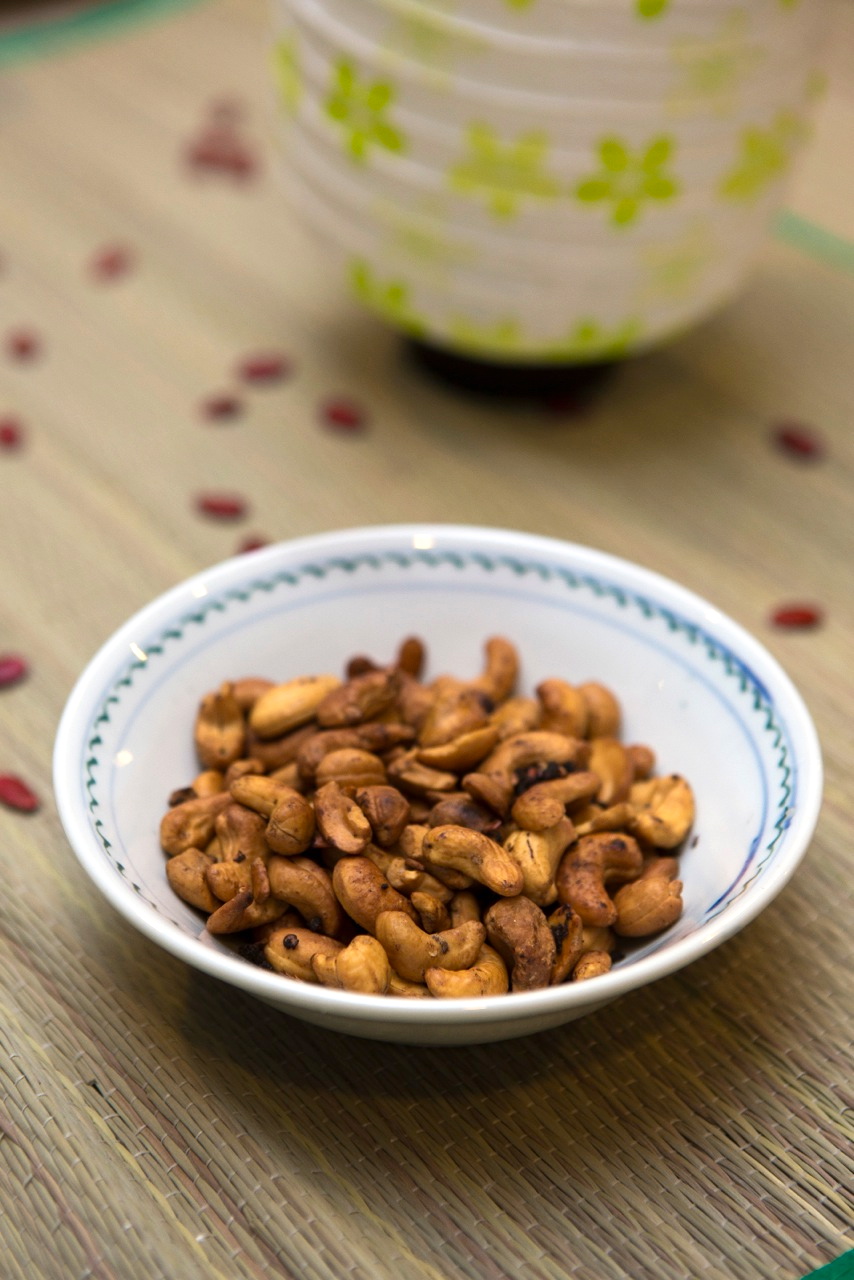
Fried Spicy Cashew Nuts/花落再重生
Fresh cashew nuts is marinated overnight, boiled, and fried until crispy. It was a snack for the family and visitors.

Roast Meat with Crystal Lard/凤干金钱鸡
Curing fat is an ancient skill, yet the knowledge to do it has mostly vanished from Singapore. The fat, known as “bing ro” or 冰肉 in Chinese, is cured in sugar for days. The end result is a piece of transparent meat with a crunchy bite. One popular use of it is as roast meat with chicken’s liver -- with each bite, you would experience three different tastes and textures in one mouthful.

Seared Semi-dried Oyster in Wine/意醋煎干蚝
This method of semi-drying and preserving oysters results in oyster that is half-juicy, yet infused with a flavor far more intense than that of fresh oysters. The oysters would first be steamed in wine, salt and sugar. Once cooked, pan-frying would sear the oyster. I then added some balsamic vinegar to the remaining juice and reduced it. Finally, the oysters were tossed into the reduction for a nice glossy finish.

Traditional Meat Roll with Chinese Ham/古式野鸡卷
This dish, which combines ordinary ingredients with intricate skill and technique, has become very hard to find. By transforming simplicity into something to wow the palate, it can be said to embody the spirit of Shunde cuisine. The meat is thinly sliced, then marinated, steamed, and fried. To balance the taste of lard, I have added a slice of caramelized pineapple.

Blanched Fish Soup/鱼边皮蛋汤
This simple bowl of soup is usually served during summer. Its key ingredient is cha gua, 茶瓜 , a preserved vegetable believed to “cool the body” during hot weather. Sadly, this ingredient is quite neglected here. This soup is very “clean”, with a pronounced taste of fish accentuated by cha gua and coriander. Traditionally, the Chinese carp is used, but I have opted for ikan parang, and used the most tender cut of the fish, located just below the dorsal fin.

Pan-fried Lotus Root Meat Cake/顺德煎藕饼
Another trait of Shunde style is the ability to come up with “101 ways” to cook banal ingredients in a tasty manner. While lotus root is usually made into soup, here it is shredded and pan-fried into a pancake. The yam in the mixture is a secondary ingredient that offers an additional level of taste.

Steamed Pork with Pearl Rice/蕉叶米沙肉
The Jasmine rice that is crushed and added as an additional coating on the pork cubes absorbs the juices and flavors of the meat. By wrapping and steaming in banana leaf (similar to the double-boiled effect), this delicate dish offers up the scent of lotus, the grainy texture of rice, and the succulence of meat cooked to perfection.

Smoked Chicken in Soy Sauce/色香太爷鸡
This recipe was created by a late-Ching Dynasty scholar, who found himself in dire straits in his autumn years, and cooked this chicken to earn a living. The dish became popular, but as the term “smoked” sounded demeaning in Cantonese, the dish’s name was later changed to reflect its creator’s official appointment at court. While smoking was a common technique in the Zhejiang area, the Cantonese hardly cook using this method.

Steamed Glutinous Rice with Cured Meat/八味糯米饭
In autumn, Shunde villagers would slaughter their animals and cure and preserve the meat for winter. They would marinate the meat, stuff it into animal’s intestines and hang it in the open field, where the dry North Wind cured the meat quickly without dehydrating it too much. I cured the pork belly myself, burying the meat in coarse salt and leaving it in the fridge for weeks. I picked dried scallops, chicken cubes and dried shrimps – similarly colored ingredients -- to give layers of taste, and a visually “neat” appearance to the dish. Another ingredient was also added: Shunde’s famous preserved radish.

Steamed Guo with Preserved Candies/芬芳竹叶果
This dessert makes an appearance only at Chinese New Year. Traditionally, glutinous rice cake cakes were steamed with a Ping-po leaf, which is native to Canton. I have replaced it with bamboo leaf, which lends the dessert its own distinctive fragrance. The stuffing is a selection of candied fruits such as tangerine, winter melon, coconut, and lotus seeds, which comes into abundance at this time of year.

Red Bean Soup with Tangerine Peel/陈皮红豆沙
Although a common Cantonese dessert soup, it is hard to find a good version of it. The beans are boiled under high heat, so that bean and water would emulsify completely. Dried tangerine peel lends a tangy hint. Tangerine peel is ready to be used only after a three-year period of maturing; and the older the peel, the mellower the taste derived from it. In fact, each year of aging seems to add another digit to its price – 50 grams of 50-year-old tangerine peel would easily fetch S$400 and above!

Credits:
Like all great parties, it was a group effort. Special thanks to Bee Bee for the wonderful menu design, Mark for his photographic eye, Jimmy for making my life less stressful, Byron and Grace for the premises, and everyone for chipping in, in one way or other. Not forgetting the two Ss for helping out in the kitchen.

..................................................................................................................................

Bits on Shunde Cuisine

Many of us would be familiar with the black-and-white ‘amahs’ of old. We may have seen them in our youth, or even lived with one in our household. The amahs’ devotion to their employers is legendary; but how many of us know of the cuisine they brought to Singapore -- the cuisine that goes by the name Shunde (pronounced ‘shun-tak’ in Cantonese).

Shunde is located about 30 minutes by train from Guangzhou, on a site that was seabed 5000 years ago. People first settled in the area in the Nanyue Dynasty (BC 203 -110), and they came mostly from Guangdong and Guangxi in China, and Hanoi in Vietnam.

In the Ming Dynasty, Shunde became a prosperous agricultural city known for its lychees and longans. It grew further economically in the Ching Dynasty, when it became renowned as the Silk Capital of Southern China.

In World War II, the town suffered occupation by the Japanese, and its population -- and fortunes -- fell from 0.85 million to 0.37 million.  The city’s inhabitants fled in a mass exodus to Southeast Asia, seeking refuge and a living. The men found jobs mostly in construction sites, while the women became the black-and-white domestic servants – the amahs -- of the rich.

Many famous Cantonese chefs hail from Shunde. In fact, it is believed that Shunde was the precursor of Cantonese cuisine, as the Chinese saying suggests “食在广州,厨出凤城”, (“Eat in Guangzhou from a Shunde kitchen”). Shunde traditional cooking employs diverse and complicated cooking techniques. In the hands of the frugal Shunde people, these skills and techniques have helped to transform mundane ingredients into dishes fit for a king.