Showing posts with label Hong Kong. Show all posts

Sunday, 28 September 2014

The Man Behind the Michelin-Starred Hong Zhou Restaurant


It was elite credentials by any standard – to be among the first batch of chefs awarded the country’s highest culinary honor, the National Grade of China; and to be recognized as one of China’s 8 most illustrious chefs. But these were not Chef Wu’s, they were his dad’s.
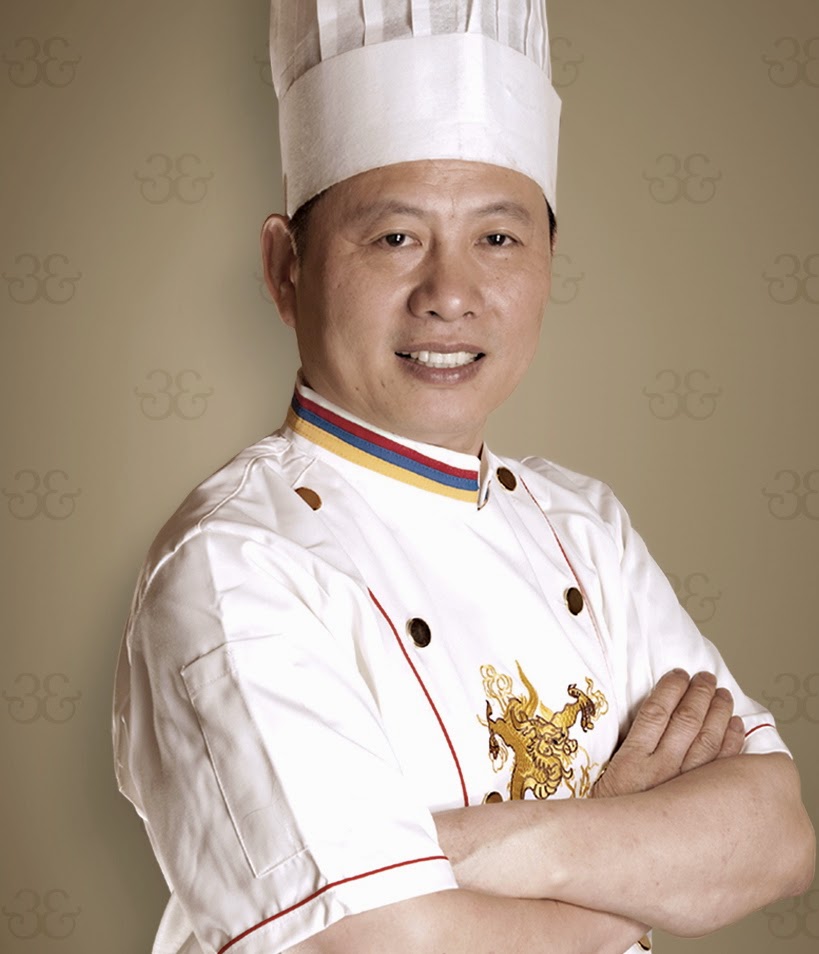
Chef Wu Rui Kang knew he had a tough act to follow. And so he became the first and only Michelin-starred chef of Hangzhou cuisine in the world.
 Chef Wu’s entry into Michelin fame was dramatic. His restaurant’s non-inclusion in the inaugural Michelin Guide Hong Kong 2008 was greeted with howls of disbelief and derision from local food magazines and netizens. The credentials of the Michelin arbiters were questioned, in particular their knowledge of the Chinese food scene in Hong Kong. The following year came the much-deserved nod from Michelin for the Chef, with a one-star ranking.

In fact Chef Wu’s sterling career was hardly heralded. After graduation from university he held a senior post in the Chinese civil service, from which he left to start a small restaurant in Hangzhou. As business grew, he decided to shift his base to Hong Kong, where his father was working at that time as executive chef for a renowned Hangzhou-style restaurant.  Chef Wu opened the Hong Zhou Restaurant in 2006.

While the Chef is, as we have seen, highly esteemed by food circles in Hong Kong, his is an audience that is ardent, initiated, and “focused”. Hangzhou cuisine, while increasingly revered in China, is still received with ambivalence in Hong Kong where Cantonese and Shanghai food reign supreme. But the Chef is patient and resolute.

Tweaking his flavors to suit the local palate is something he has stood against from the start, while the use of air-flown ingredients all the way from Hangzhou is a practice he has always insisted on. Such rigorous measures -- and not half-efforts and compromises -- are what he believes authenticity and reputations are built upon, and what he believes will ultimately win him a large audience for his beloved cuisine. Now he has the star to prove it.

But what makes a great chef? Chef Wu proposes a combination of assets: kitchen ethics, intelligence, and innate gifts. Kitchen ethics implies respect and humility, especially before teacher or master, he says, and the willingness to give your best in everything from cooking to personal hygiene. In short: attitude.


Intelligence is the drive for technical mastery. Chef Wu lists essential areas such as kitchen skills, cost control, and financial/business acumen. Finally, innate talent and passion is a factor. But, stressed the Chef, it must be coupled with a lot of hard work.
Only then will innate gifts make a difference, and raise the aspiring chef above all the others to greatness.


Hong Zhou Restaurant
1/F Chinachem Johnston Plaza
178-186 Johnston Road, Wanchai, Hong Kong
Tel: +852 2591 1898

Saturday, 6 April 2013

Wing Beans – Adding Zing to Greens


I was introduced to wing beans late in life. I remember it pretty well – it was an office lunch, a potluck, and one of my Malay colleagues contributed an interesting Asian salad.  Its sauce was fairly typical: prawn paste (hei go), crushed peanut, assam juice, and chili sambal; quite similar to rojak. But the combination of greens was intriguing. There was turnip, pineapple, ginger flower, guava, snake fruit, and of course, wing beans.

Just like aragula, wing beans contribute a surprising, refreshing “green” taste, and a hint of bitterness. Wing beans basically add depths of sweetness and a hint of "rawness" to any veggy cocktail, and because of that, I fell in love with it. Nowadays I like wing beans however it’s done -- in salads or simply fried with belachan.

When a Hong Kong newspaper asked me for a Singapore recipe for their Singapore supplement, I contributed the one below without hesitation.


Wing Bean Salad

Wing bean                             1 cup
Long bean                              ½ cup, blanched in hot water
Cucumber                              ¼ cup, cubed
Red chili                                  2, sliced thickly
Onion                                      ½, sliced thickly

Garnishing:
Fried shallots                      2 tbsp   
Dried shrimps                     2 tbsp, soaked and deep fried
Coriander                             1 sprig, sliced

Salad Sauce (mixed thoroughly):
Sriracha                                  3 tbsp
Tomato                                  1 tbsp
Peanut oil                              ¼ cup
Calamansi juice                   1 tbsp
Sugar                                       ½ tbsp
Salt                                           ¼ tsp
White pepper                      ¼ tsp
Durian                                    3 seeds, deseeded
Calamansi                             2, juiced
Sugar                                      1/3 tbsp
Salt                                          a pinch

Method
1.              Assemble all ingredients in a mixing bowl.
2.              Pour salad sauce slowly and toss with the ingredients until it is sufficiently wet.
3.              Spoon the salad in a serving bowl and top with the garnishings.

Sunday, 17 March 2013

Seared Golden Oyster – Quick-to-cook Delicacy


I love dried oyster. In fact I grew up eating dried oysters in many forms and dishes. Most commonly seen at home would be the classic Cantonese dried oyster porridge with dried sole fish, or the must-have Chinese New Year reunion dish: dried mushroom, oyster and black moss stew.


When I moved to Hong Kong in 2007, I saw semi-dried, huge oysters stringed on bamboo sticks. Later, I found out that it was a delicacy, in which fresh oysters were sunned for a few days before hitting the market. The taste is more robust than the fresh ones, but less “smoky” than dried oysters.

Cooking these oysters is easy. Marinate them with Chinese wine, salt and sugar, then steam them for a couple of minutes and finish them by searing with honey. I made a slight twist at the final stage, for I love the taste of Balsamic vinegar reduction with oyster.

So, here is my version. Enjoy!

Seared Golden Oyster

Semi-dried oysters                            12
Peanut oil                                             2 tbsp
Balsamic vinegar                                1 tbsp
Sugar                                                      ½ tsp

Marinate:
Chinese yellow wine                        2 tbsp
Ginger juice                                         1 tbsp
Premium soy sauce                          1 tbsp
Sugar                                                     1 tsp
Salt                                                         ¼ tsp
White pepper                                     ¼ tsp

Method:
  1. Remove oyster from the bamboo stick carefully.
  2. Brush the side of oyster with a brush under running water.
  3. Marinate oyster for 10 minutes.
  4. Steam oyster for 20 minutes.
  5. Remove oyster and drain thoroughly. Keep the juice aside.
  6. Slightly brown oyster with peanut oil on both sides. Remove and set aside.
  7. Using the same pan, reduce oyster juice, balsamic vinegar and sugar until they thicken. Adjust taste accordingly.
  8. Toss oyster in the reduction until well mixed.
  9. Serve immediately.

Tuesday, 27 March 2012

Killer Dim Sum!


I first heard about it in November of 2011 -- how famed masterchef Chen Xun had been coaxed out of retirement for a month-long dim sum promotion in Guangzhou. I was not able to make that trip, and have regretted it since. It was a meal I would have gladly killed for.

The Guangzhou-based 87-year-old Chen is regarded as one of the greatest dim sum masters of his generation. He is advisor to the Guangzhou Culinary Association and author of many cookbooks.

赤绳欣系足
So imagine my surprise and glee when I learned that the masterchef had been invited to repeat his feat, this time in Hong Kong for two weeks. A few days back I finally found myself seated at Nanhai No.1 restaurant in Tsimshatsui, looking at dim sum that had been served by Chen since the 1940s.

We opened with Steamed Mountain Yam and Duck Web with Bean Curd Skin (right). The duck web had been braised and steamed along with the yam, allowing the yam, which was tied together with string made from an omelette, to thoroughly imbibe the flavour of the duck web. The taste was subtle with a light hint of superior soy sauce.
彩风隐龙怀
Next came Steamed Prawn stuffed with Quail Egg (left).  The prawn was minced and beaten into a paste that was smooth and slightly crunchy. The acid test for me was the taste of prawn, which came through with light seasoning. The quail egg also gave a heavier body to the bite.

This was followed by morsel-sized pastry birds, actually Baked Chicken Liver Pastry seasoned with Spring Onion Oil (below, left). The liver was light in taste, unlike the heftier flavour of most chicken liver. The pastry was typically Chinese in style, and a little on the heavy side with a hint of spring onion oil.
葱油凤肝酥 (left), 窝烧鸭脑饼 (right)

The fourth item was unusual---Baked Duck’s Brain Pancake with Cinnamon Flavour (above, right).  Each pancake used two duck brains blended with minced meat. The taste of duck brain was subtle but the texture was unforgettable. It reminded me of tofu but with a meatier smoked taste. My favorite!
茄汁鲜虾饺

When the ha kou was presented, it looked like any other ha kou except for a pronounced red blush shining through the skin. The first bite of the Steamed Shrimp Dumpling with Fresh Tomato (right) produced a light hint of tomato sourness accompanied by the crunch of prawn paste.  But the second bite clearly justified the presence of the tomato paste; the flavor of tomato and prawns is a marriage made in heaven. Yum!

I’ve never been fond of chicken siu mai (below, right), and the only occasion I would eat chicken siu mai would be in Muslim Malaysia, where the use of pork in hotel restaurants is forbidden. But Masterchef Chen Xun’s version was exquisite, the meat finely chopped and marinated with superior oyster and soy sauces. The meat on its own was already flavoursome but the marinate enhanced it even further.
网油牛肉卷 (left),  鸡茸干蒸卖 (right)

The Steamed Beef Ball (above, left) was lean beef hand-chopped, and wrapped in caul-oil which serves to moisten the meatball during steaming. The beef was further enhanced with dried mandarin peel, water chestnut, lemon leaves and coriander. From the first bite the parade of flavours from the ingredients came through, one after another!

柚皮火腩夹
The preparation of pomelo skin is always tedious and time-consuming, making pomelo skin as an ingredient a rare treat in restaurants. Masterchef Chen Xun mixed Pomelo Skin with Pork Belly (left) and cooked it until soft. The final mixture was then stuffed into a bun and steamed for about 20 minutes, giving it a refreshing taste quite unlike the usual char siu or chicken bun. Furthermore, the pomelo skin soaked in the oil from the pork belly, while sending hints of fruitiness seeping through the meat.

Two desserts were prepared and served for this promotion. The first was lotus paste coated with flour mixture and sesame seeds (below, right), and deep-fried until golden brown. The lotus paste was light and not too sweet like most Chinese desserts. And the sesame seeds gave a nice bite with a pungent seedy flavor.
波渣香麻条

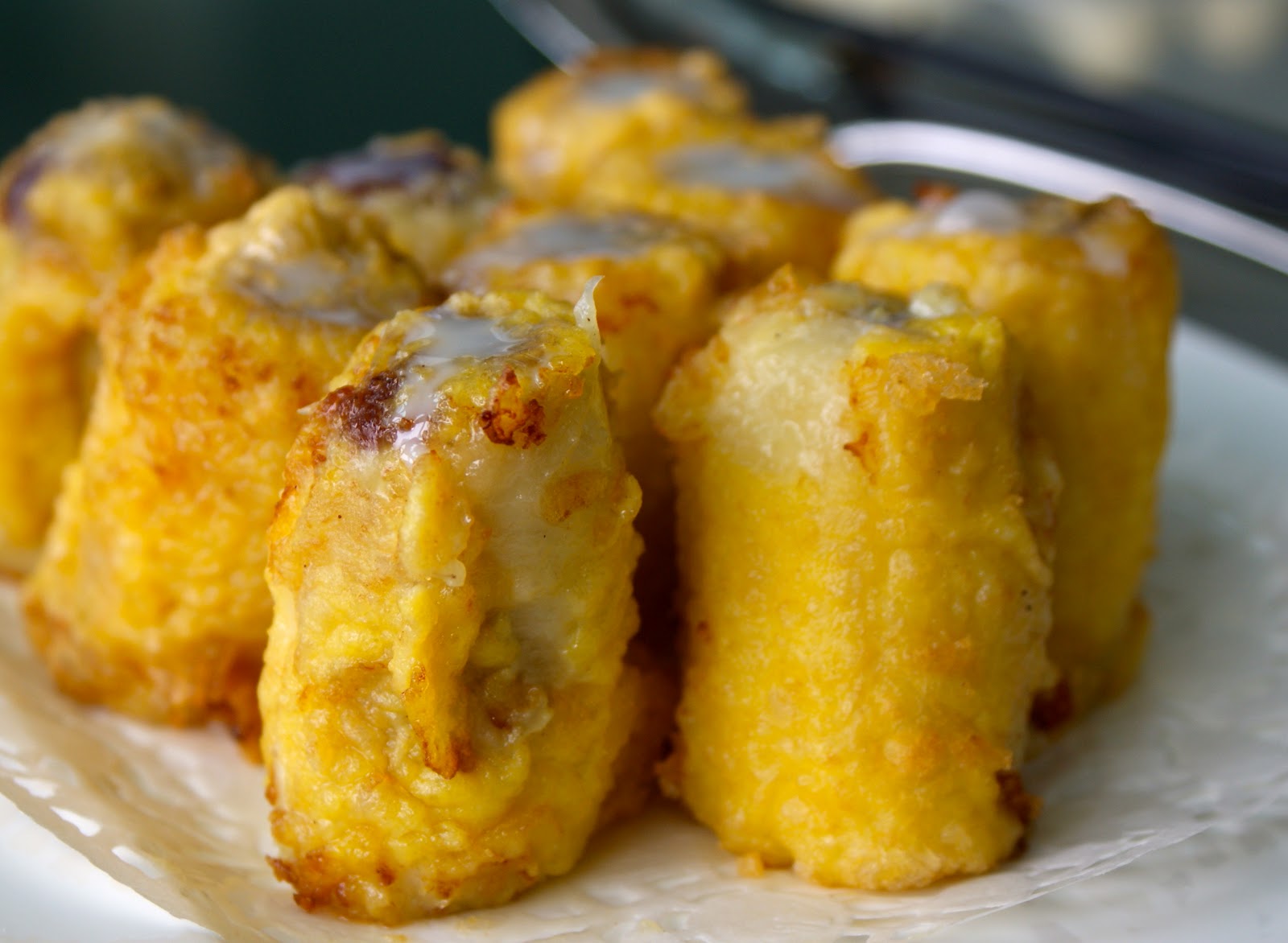
The last dessert was my favourite -- deep-fried Banana stuffed with Red Bean Paste (below, left). The combination was refreshing and somehow tasted modern. But the restaurant staff assured me that such a combination had already existed more than 50 years ago.

NANHAI NO. 1
Level 30, iSquare
63 Nathan Road
Tsimshatsui, Kowloon
HONG KONG
Tel:   852 2487 3688

脱衣换锦袍